A Practice Born From Goodbye
Kam grew up near Malaysia's capital, and by his own account, he was not a natural athlete. He remembers shrieking in gym class when asked to run. Movement, at that point, was something that happened to other people. Then came the prospect of leaving. Like many ambitious young Malaysians, Kam planned to emigrate to the United Kingdom for education and professional opportunity. The move was exciting. It was also devastating, because it meant leaving behind his mother, who he describes simply as his best friend. In the weeks before departure, searching for some ritual that could hold them together across an impending 7,000-mile gap, he spotted a yoga billboard across the street from home. "Should we check that out, mom?" he remembers asking. They did. And that was the beginning. "My mom is my best friend," Kam tells Queerty. "Movement is a way to bond without words." Years later, the two still practice together in spirit across continents, connected by something that started as a last-minute experiment in staying close.From Architecture to the Body as Architecture
Kam initially moved to the UK to study architecture. Eventually he relocated to London to pursue dance full time, and his formal training took him to the Trinity Laban Conservatoire of Music and Dance, one of the UK's most respected institutions for contemporary movement. There he specialized in choreological studies, an approach grounded in the analytical framework developed by Rudolf Laban, the Austrian-Hungarian choreographer and theorist widely regarded as one of the founding figures of expressionist dance. Laban Movement Analysis, or LMA, is a rigorous method for describing, interpreting, and documenting human movement. It is used today in dance education, actor training, physical therapy, and somatic practice. When Kam describes being able to read a person through the way they step, the way their hands meet the ground, the rhythm of their breath, he is not being mystical. He is doing something he was academically trained to do. "We communicate so much nonverbally, even down to posture," Kam explains. "You can see the kind of effort and sensitivity they have and the reflexive energy they default towards. You see their level of tentativeness." He draws a characteristically grounded example: the way someone moves can tell you whether they are the person who arrives five hours before a flight or the one who is dilly-dallying and arrives two minutes before the plane takes off and still thinks they have time. Kam now teaches as a dance lecturer at Trinity Laban on both Bachelor and Master programmes. He is also currently an Activist in Residence at King's College London, where his research sits at the intersection of movement, migration, and digital technologies. That last thread, migration, runs all the way back to the yoga billboard in Malaysia.Beyond Asana: A Queer Approach to Flow
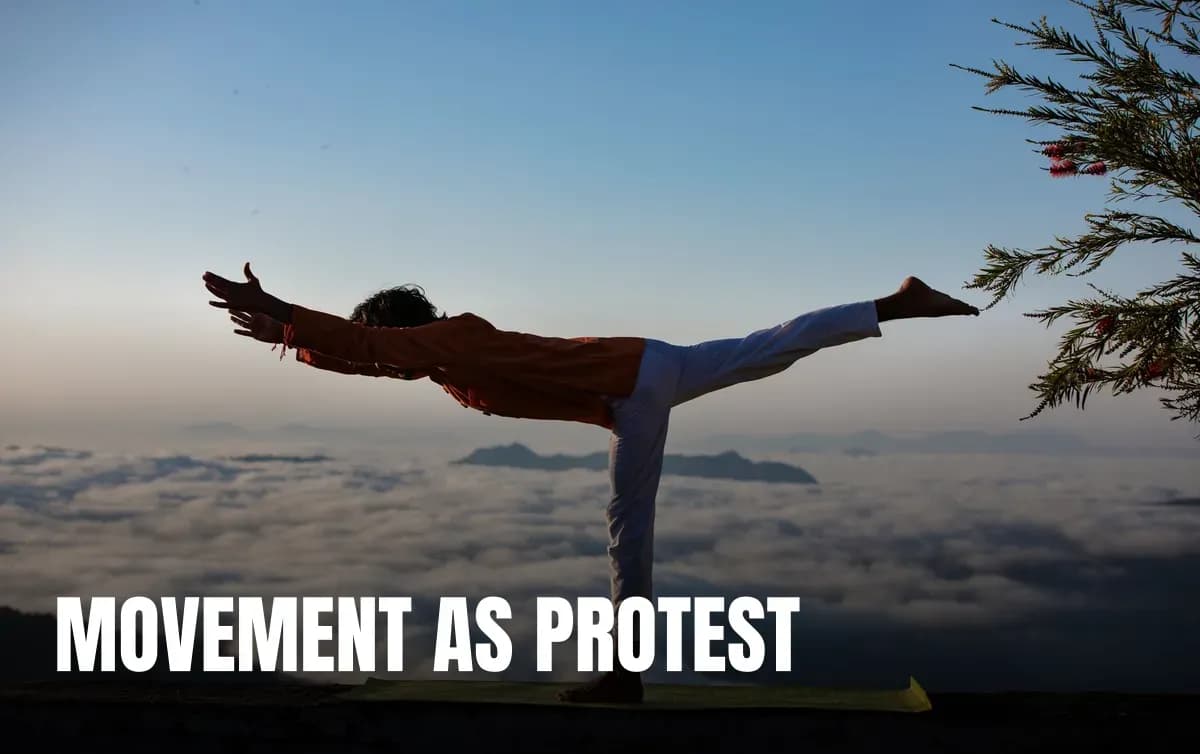
Kam describes his signature practice as "beyond asana." In yoga, asana is a Sanskrit term for the physical postures. Kam starts there, in traditional form, and then opens into something looser and more personal: a free-form flow that follows the body's own internal logic rather than a choreographed sequence. The destination is flow state, a condition of full immersion and rhythmic self-alignment that positive psychologists Mihaly Csikszentmihalyi and Jeanne Nakamura helped formalize in the late twentieth century, though spiritual traditions across the world had been pointing toward it for millennia. Csikszentmihalyi described flow as "the optimal state of human consciousness, where we feel and perform our best." Yoga is considered one of the activities most reliably capable of producing it, because its combination of breathwork, posture, and meditation engages multiple channels of awareness simultaneously. Kam's Beyond Asana framework leans directly into this: according to his own description, flow is "prioritised over posture, using movement patterns to reveal gaps in our awareness and develop grace." Crucially, on his own platform, Kam frames Beyond Asana explicitly as a queer, multimodal approach to movement. That framing is deliberate. Kam identifies as a cis-queer Hakka Chinese Malaysian, and his practice carries the weight of that identity openly. He describes movement as "an expression of both party and protest," a phrase that takes yoga well outside the wellness studio and places it inside a long tradition of queer embodiment as resistance.Community Over Commodity
One of the more striking things about Kam is how consistently he pulls yoga back toward accessibility and away from the premium-retreat aesthetic it has accumulated in the West. Yes, he leads retreats. His favorite location so far: Norway, in October, with northern lights visible and water drinkable straight from the lakes. But he is also the person doing chair yoga with elderly South Asian residents at a community center in North London, practicing in a courtyard while a nearby vendor smoked pork belly. There was no sage. No incense. Just lunch in the air and bodies moving together. "Peace is really a state of mind," Kam says. "Going back to mental flexibility, how can you play with intention, so you can channel your energy towards where it needs to be?" He pushes back gently but firmly against the idea that peace requires a specific container, a retreat, a cube of carefully lit studio space. You can find it on a bridge during a flash mob yoga session too, which he has done, noting that a dad once told him he brought his whole family because yoga was a free and accessible thing they could do together. This community orientation extends into Kam's founding of kindredpacket, a grassroots movement dedicated to uplifting East and South East Asian communities through culturally sensitive practice. The work is explicitly rooted in community organizing. His research at King's College on movement and migration also connects directly to this: Kam's yoga story begins with diaspora, with the grief of leaving home and the creativity of finding connection across distance.The Favorite Posture Is Just Standing
Ask Kam his favorite posture and the answer is immediate: tadasana, mountain pose. Just standing. "Because it's so universal and it's so profound," he says. "You are reminding yourself that you are of nature, you are a mountain. There are so many intricacies to simply standing." He points out that the body is never actually still, even in stillness there is motion, breath, pulse, the subtle negotiation of balance. Tadasana, in his reading, is less a posture than a question: how am I feeling right now, in this body, in this moment? "Your body is your home," he says. "Your body is what carries you." Off the mat, Kam has been investing in voice work, driven initially by a pragmatic concern. If he breaks a leg, he can still teach. Lose his voice and he loses that flexibility. But the singing has become something more: cathartic, releasing, a way of attending to the jaw tension he suspects many people carry without knowing it. He has traded one expressive body for the whole instrument.Why It Matters
The yoga world, particularly in the UK and US, has a well-documented representation problem. Despite yoga's South Asian roots, Western studio culture has historically centered a narrow image: white, thin, female, wealthy, and above all, flexible. Kam's existence in that space, as a visibly queer Hakka Chinese Malaysian man teaching movement as "party and protest," is not incidental. It is the whole point. His framework insists that mental flexibility matters more than the physical kind. That accessibility matters more than aesthetics. That the family who showed up to the bridge yoga session because it was free deserves the same practice as the retreat attendee in Norway. That a queer diaspora kid who once shrieked in gym class can grow up to teach elderly South Asian neighbors that their bodies are still worth moving in, pork belly fumes and all. "I'm not flexible enough" is, by Kam's reckoning, the number-one thing he still hears as a reason not to start yoga. His reply is direct: "Well, then start!" The body you have is the one that carries you. That is the home. It is available right now, wherever you are standing.Source: Queerty
Cover photo: RAY LEI / Pexels