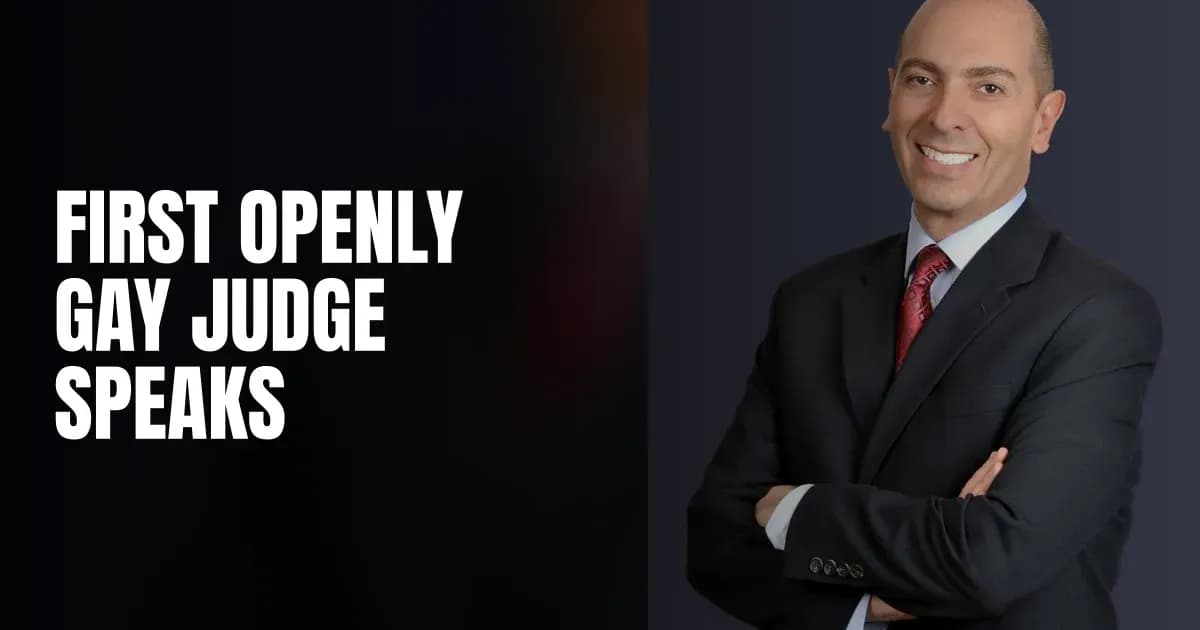
In the mid-1970s, a lonely nineteen-year-old at Queen's University spotted a tiny ad in the student newspaper and walked, terrified, into a room that would change the rest of his life. That young man became Harvey Brownstone, Canada's first openly gay judge, and the story of that walk is now at the heart of his new memoir, Without Prejudice: My Life as a Gay Judge.
Growing Up Without a Mirror
Brownstone, born in 1956, came of age in an era when gay identity was effectively invisible. Schoolyard bullies called him names he didn't initially understand, but by his early teens the meaning was clear enough. What wasn't clear was that anyone else felt the way he did. In the early 1970s, he writes, homosexuality simply did not appear on television or in movies as far as he knew. His only cultural reference point was Liberace, whose flamboyance made him wonder whether he himself really belonged in that category at all, since he felt nothing like the performer.
His mother, a French-Algerian Holocaust survivor who had arrived in Canada speaking almost no English, kept close watch over him. He describes her as loving but suffocating, checking his breath and hair for signs of alcohol or cigarettes each time he came home. The household's anxieties, rooted in genuine historical trauma, left him craving independence. University, and distance, felt like the only way out.
A Tiny Ad, A Grey House, A Room Full of People
Queen's University in Kingston offered him a scholarship to study French and political science starting in September 1975. His parents paid his way. But campus life quickly revealed a new kind of loneliness: the men in his residence thought about little beyond sex with as many women as possible, and Brownstone had nothing in common with them. He sat alone in his room most nights, wondering how and whether he would ever find anyone like himself.
Then he noticed the ad. The Queen's Homophile Association held weekly meetings. He had to look up "homophile" in the dictionary. What he found in that meeting at the campus Grey House, which some students condescendingly renamed the "Gay House," was roughly twenty people seated in a circle: students, faculty members, and community residents. No one matched the stereotypes he'd absorbed from a culture that only offered caricatures. No one looked like Liberace.
"My name is Harvey. I'm a first-year student from Hamilton. And I think I might be gay."
Harvey Brownstone, Without Prejudice
That halting self-introduction, croaked out to a circle of strangers, was the first time Brownstone said the words out loud. The group's knowing, welcoming response was the first confirmation that he was not, as he had feared, entirely alone in the world.
What Came After
The memoir does not stop at that warm meeting room. Coming out to his parents at nineteen resulted in his being thrown out of the house. He spent years on welfare before rebuilding his life and eventually pursuing law. On March 13, 1995, he was appointed to the Ontario Court of Justice, becoming the first openly gay judge in Canada. That appointment came roughly twenty years after the night he walked into the Grey House.
The bench brought its own forms of hostility. On his first day, colleagues arranged a lap dance in what Brownstone describes as a kind of institutional "conversion therapy." His 26-year judicial career included presiding over family and criminal courts, officiating hundreds of same-sex weddings, and a bid for chief justice that he describes as "a fiasco" he attributes to his identity. Now retired and no longer bound by the traditional restraints on judges, he is free to say all of it plainly.
A Hollywood Ending, Almost
A feature film adaptation of the memoir is currently in post-production. Directed by Shane Stanley, it stars David Arquette as the adult Brownstone and David Mazouz as the young Harvey. A fall 2026 premiere is expected, which would make the film a timely companion to the book's release this Pride Month.
The casting of Arquette and Mazouz gives the adaptation real commercial reach, and the source material is genuinely cinematic: eviction, poverty, institutional sabotage, and a historic first.
Why It Matters
Brownstone's coming-out story is, on its surface, deeply personal: a teenager in a 1975 dormitory, a dictionary definition, a borrowed house on a university campus. But it sits inside a much larger arc. The era he describes was one in which gay people had almost no public representation and no legal protection. Billy Crystal's character on Soap did not premiere until 1977, two years after that first Queen's University meeting, and even that landmark moment was still highly contested at the time. Brownstone had nothing to guide him except his own feelings and, eventually, a three-line ad in a student paper.
What makes the memoir more than nostalgia is everything that followed the coming-out: the eviction, the welfare years, the judicial appointment, the blocked promotion, the hundreds of same-sex weddings he officiated at a time when many of his colleagues would not. Brownstone's argument that both family court and criminal court are structurally broken carries unusual weight because it comes from someone who spent a quarter century inside the system, and who was treated by that system as less than fully welcome from day one. He is, as he puts it, no longer shackled by judicial restraint. The result is a document that reads as both memoir and institutional critique.
Without Prejudice: My Life as a Gay Judge is available now wherever books are sold.
Source: Queerty
Cover photo: Advicescene, CC BY-SA 3.0, via Wikimedia Commons