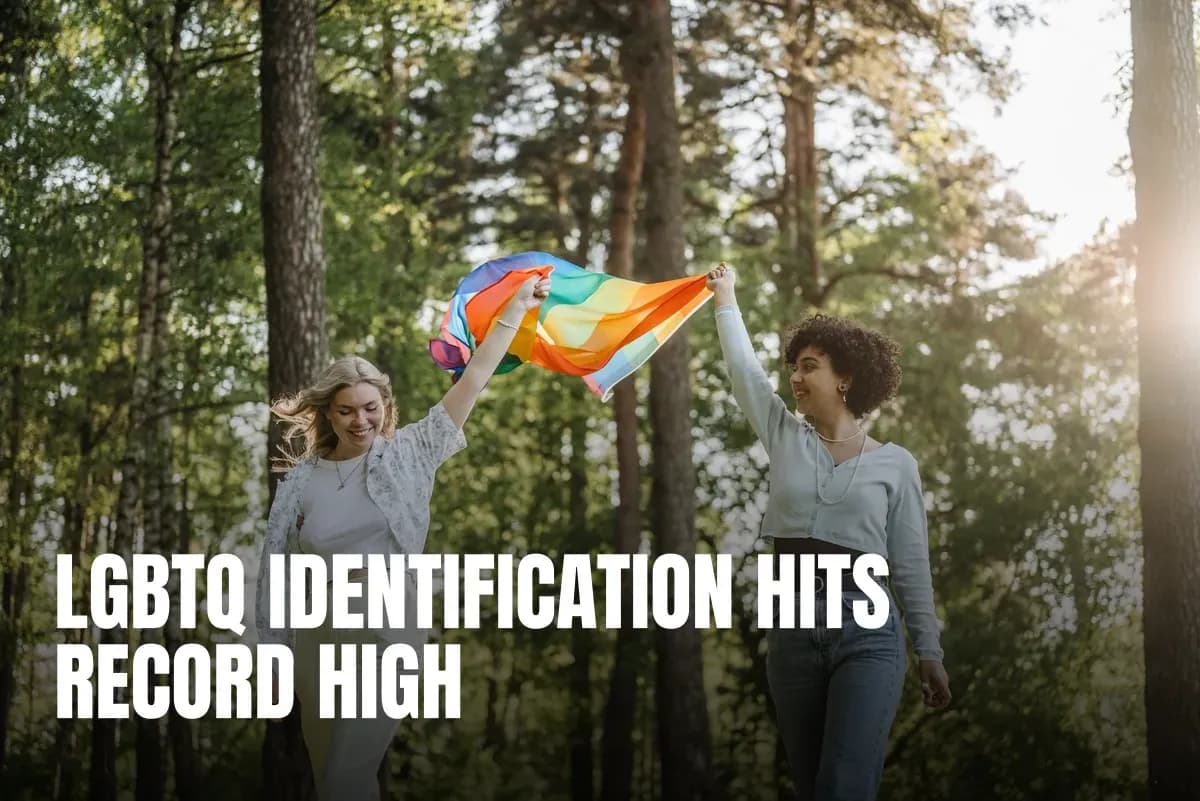
A new analysis from the Human Rights Campaign Foundation puts the share of LGBTQ+ adults in the United States at 12%, the highest figure any major survey has ever produced, and finds that nearly one in three adults under 25 now identify as LGBTQ+.
A New High-Water Mark
The report draws on one of the largest datasets ever used to measure LGBTQ+ identity in America: 2.45 million responses to the Census Bureau's Household Pulse Survey, an online, self-administered questionnaire that briefly included sexual orientation and gender identity items. That method matters. Gallup's benchmark figures come from live phone interviews with roughly 10,000 to 13,000 adults a year, a format where some people may hesitate to disclose an LGBTQ+ identity to a live interviewer. HRC's online approach, run at far greater scale, found a notably higher number, and researchers suspect even that figure understates reality, since respondents still had to feel safe enough to answer a federal survey honestly.
The transgender findings stand out. HRC's analysis puts transgender and gender-expansive adults at 2.34% of the population, more than double Gallup's 1.1% estimate. Earlier surveys had placed transgender prevalence somewhere between 0.5% and 1% of U.S. adults, so a figure north of 2% suggests the community has long been undercounted rather than newly growing.
Removing LGBTQ+ people from federal data collection does not make our communities disappear; it makes them harder to see, understand, and serve.
HRC Foundation report
Young People Are Leading the Shift
The generational split is the clearest story in the data. Nearly one in three adults under 25 identify as LGBTQ+, and more than half of all LGBTQ+ adults, 53.8%, are between 18 and 34. Gallup's own polling backs up the trend line: trans identification sits at just 0.2% to 0.3% among older generations but reached 1.9% among Gen Z adults in 2022. Bisexual adults now make up more than 7% of the entire U.S. adult population, the single largest slice of the LGBTQ+ total, with the HRC data showing about 65% of LGBTQ+ adults identifying as bisexual, pansexual, or another non-gay, non-straight identity, and roughly one in five as gender-diverse.
Where LGBTQ+ Americans Live
LGBTQ+ adults now exceed 10% of the population in 40 states plus Washington, D.C. Oregon and Washington top the list at 17% and 16%, followed by Colorado, Alaska, and California, each around 14%. Alaska's presence is a genuine surprise: a red state with weaker civil rights protections that has nonetheless avoided the worst of the anti-trans legislative wave sweeping other conservative states. Notably, several electoral battlegrounds, including Arizona, Georgia, Michigan, New Hampshire, North Carolina, and Pennsylvania, are also above that 10% threshold, a detail with obvious political implications heading into future elections.
Why It Matters
The headline finding here isn't just a bigger number, it's what that number says about the last decade. Anti-LGBTQ+ political rhetoric has intensified since the mid-2010s, yet identification has climbed the entire time, from 3.5% in Gallup's 2012 tracking to 9.3% by 2024. People aren't disappearing under pressure; they're coming out anyway, especially the youngest adults, who appear to feel freer to name who they are than any generation before them. That's worth sitting with: the loudest anti-trans and anti-gay campaigns of recent memory have not produced a quieter, smaller community. They've coincided with a larger and more visible one.
Reliable data are essential for understanding who lives in this country and what our communities need to thrive.
Tari Hanneman, HRC Foundation
MQ's Take
We'd treat this less as a victory lap and more as a snapshot that may never be repeated. The Household Pulse Survey was one of the last large federal instruments still asking about gender identity, and the current administration has already pulled those questions from hundreds of other data collections. Gallup's 2025 polling already shows LGBTQ+ identification holding flat for the first time since it started tracking in 2012, a hint that the political climate may be starting to chill disclosure again. If federal data collection keeps shrinking, this may be the clearest picture of who we are that researchers get for years. That makes it worth remembering, and worth defending.
Sources: Erin in the Morning, Xtra
Cover photo: Pavel Danilyuk / Pexels