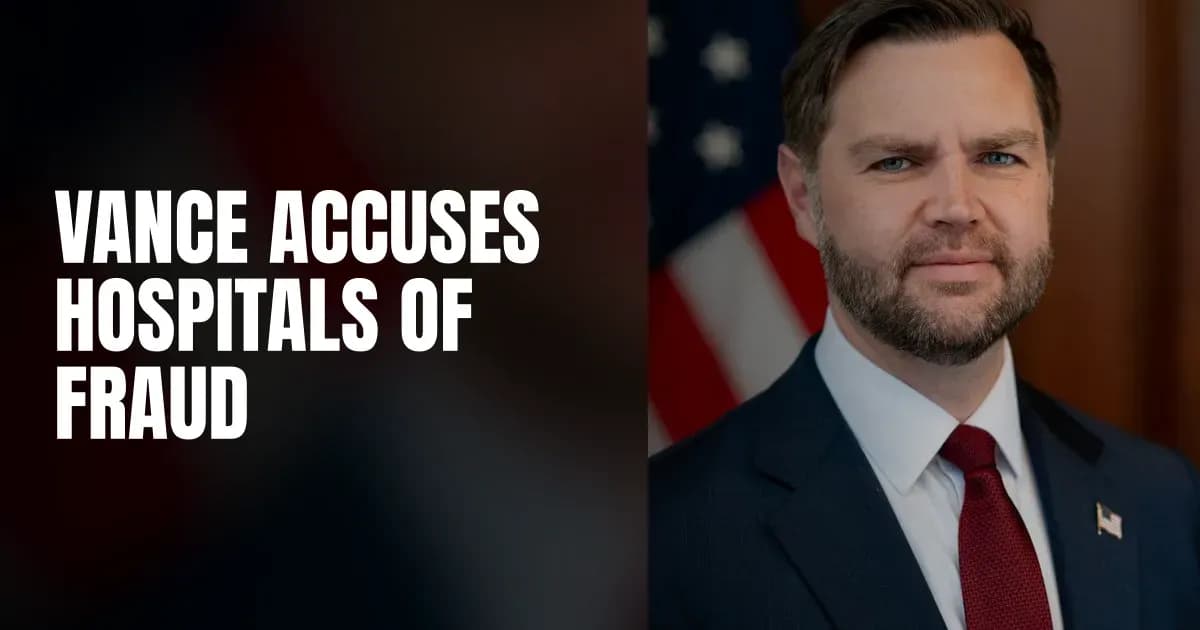
Vice President JD Vance and the Department of Health and Human Services are accusing more than 200 hospitals and clinics nationwide of committing insurance fraud by providing gender-affirming care to trans youth, opening a new legal front in the Trump administration's campaign to end that care altogether.
A Familiar Fight, a New Legal Angle
The report, titled "Wolves in White Coats: How Doctors and Hospitals Pushed and Profited from the Fraud of 'Gender Medicine,'" argues that hospitals mislabeled gender-affirming treatment for minors as young as 9, using codes like "endocrine disorder, unspecified" or "precocious puberty" instead of billing it plainly. By definition, no one 13 or older can be diagnosed with precocious puberty, and the report treats that mismatch as evidence of intentional deception rather than imprecise coding. Vance, acting as chairman of the White House Task Force to Eliminate Fraud, sent letters to Attorney General Todd Blanche and HHS Inspector General T. March Bell instructing them to investigate more than 200 hospitals and clinics, including Boston Children's Hospital and Mount Sinai, for "possible violation of federal statutes."
Who Built the Case
The report leans heavily on Do No Harm and the Independent Women's Forum, two groups with a long track record of opposing gender-affirming care, and its language mirrors their advocacy: it refers to the care as "Sex-Rejecting procedures" and frames every provider's motive as profit rather than patient need. That framing runs headlong into the position of every major U.S. medical association, which continues to recognize gender-affirming care as medically appropriate. It also arrives just two days after the Centers for Medicare and Medicaid Services cut off Medicaid funding to hospitals offering the same care to minors, part of a pattern rather than a coincidence.
You cannot hand-pick a panel of anti-transgender activists, feed it research from anti-trans advocacy organizations, publish the result under an HHS banner, and call that independent science.
Kelley Robinson, Human Rights Campaign
The Math Behind the Fraud Claim
The report's own numbers complicate its urgency. Figures cited in coverage range from roughly $50 million to $60 million in flagged insurance claims, but that total spans a full decade, 2015 to 2025, across a nationwide system of care. Divided out, it works out to a fraction of hospital billing in any given state or year, hardly the picture of a runaway profit scheme the report's title suggests. If providers did apply codes loosely, the more mundane explanation is that they were trying to keep patients covered and care flowing, not lining anyone's pockets.
This isn't the administration's first attempt to use fraud as a legal wedge. For more than a year, the Justice Department has subpoenaed medical records from trans youth patients at over 20 hospitals under the guise of investigating off-label prescribing, a common and legal practice in medicine generally. Judges have repeatedly quashed those subpoenas, calling them a "fishing expedition" meant to "harass" and "intimidate." Earlier this week, the DOJ asked an appeals court to drop one such case entirely, a retreat that now looks less like a change of heart and more like a pivot to this new fraud framing.
Our Read
Stripped of the loaded language, this report asks Americans to believe that pediatric endocrinologists and children's hospitals are running an elaborate insurance scam to profit off treating gender dysphoria, a claim with no support from any independent medical body and one that ignores the actual scale of the money involved. What it does accomplish is adding a new tool, federal fraud investigation, to a toolbox that already includes Medicaid cuts, subpoenas, and executive orders. Each one raises the cost and risk of simply doing the job of caring for trans patients, which is very likely the point.
Alongside the report, HHS released a 12-minute video built around a handful of detransitioners and anti-trans activists. One person who appears in earlier public accounts and is often cited in this debate, filmmaker Emma Curtis, has described a very different arc: she detransitioned not because she felt coerced, but because of the harassment she faced as a visible trans woman, and later returned to transition again.
Six years later, I can firmly say that gender-affirming care literally saved my life.
Emma Curtis
What to Watch
According to the Movement Advancement Project, 27 states and one territory already restrict gender-affirming care for trans youth through law. This report gives the administration a federal mechanism to pressure hospitals in the states that haven't. Whether any of the more than 200 flagged hospitals actually face charges, or whether courts treat this the way they've treated the DOJ's subpoenas, will say a lot about whether "fraud" holds up as a legal theory or simply functions as another chilling headline.
Sources: LGBTQ Nation, PinkNews
Cover photo: Emily J. Higgins, Public domain, via Wikimedia Commons