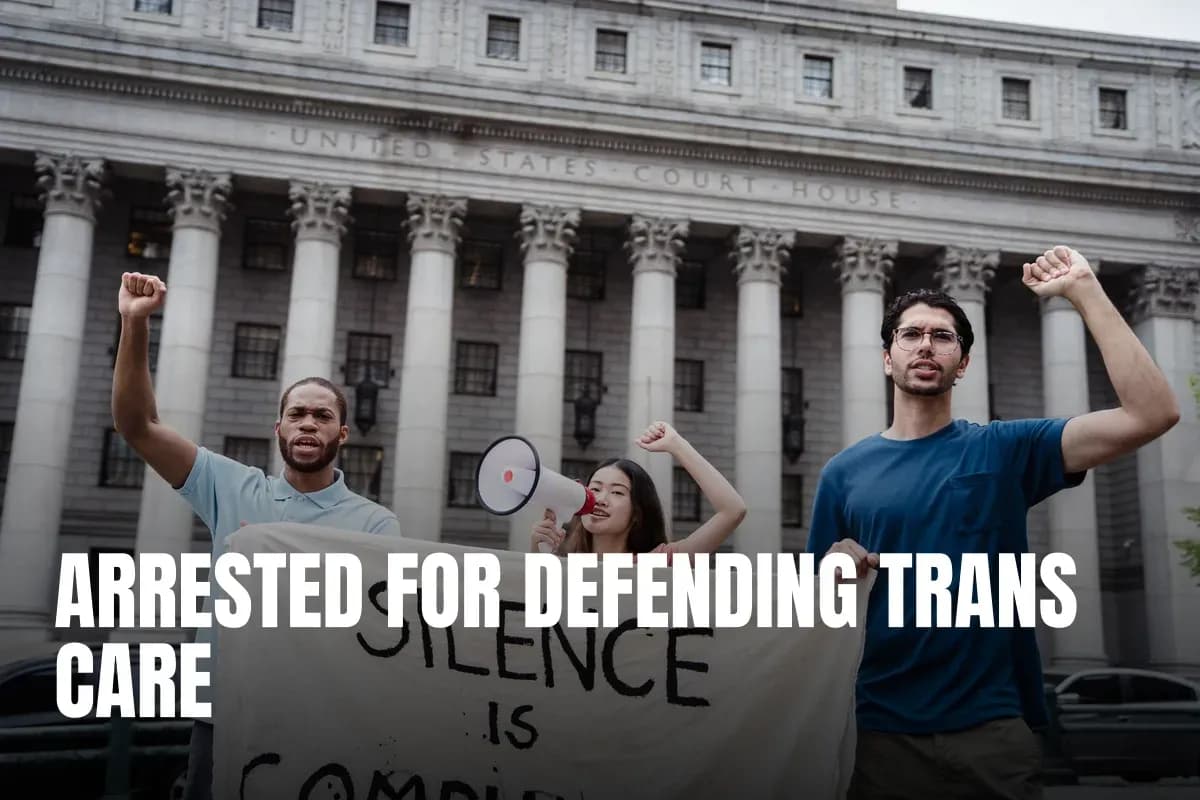
Nine trans rights organizers were arrested in Boston on Wednesday after occupying the lobby of Massachusetts Attorney General Andrea Campbell’s office, demanding she force local hospitals to reinstate gender-affirming care for minors that they quietly stopped providing under pressure from the Trump administration.
A Sit-In With Syringes
The protest was pointed by design. Organizers didn’t just chant outside the building, they carried their own hormone gels, pills, needles and sharps containers into the lobby and administered their own care there, a visceral reminder of exactly what’s disappearing from Massachusetts hospitals. When the office closed for the day, they stayed. An assistant attorney general eventually offered them a meeting, the same offer organizers say they’d already accepted months earlier with nothing to show for it. State troopers arrested nine people, including Walker, who shouted “Act up! Fight back!”, the decades-old rallying cry from AIDS activists, as he was taken away.
The Safe Haven With Fine Print
Massachusetts is supposed to be one of the country’s safest places for trans people to live. It has a shield law protecting providers and patients from out-of-state prosecution, a governor in Maura Healey who is the state’s first lesbian chief executive, and a senator, Edward Markey, who just won a competitive primary in a race largely fought over trans rights. Gender-affirming care remains fully legal there. None of that has stopped the chilling effect from the Trump administration’s threats: an executive order to cut federal funding from hospitals providing youth care, followed by an effort from health secretary Robert F. Kennedy Jr. to squeeze Medicaid reimbursements. Courts have blocked much of it, and there are no confirmed cases of a hospital actually losing federal funds over this care. But the fear alone was enough.
Hospitals Blink First
Fenway Health, the state’s largest LGBTQ+ health provider and the clinic that made New England’s first AIDS diagnosis, stopped youth hormone therapy and puberty blockers last October. Outer Cape Health Services and Baystate Health, which serves western Massachusetts, followed. Baystate has said the threat of losing hundreds of millions of dollars in Medicaid and Medicare reimbursement, funding tied to nearly 70 percent of its patients, drove the decision. A fourth hospital canceled gender-affirming surgery appointments for adult trans women, even though Trump’s order never targeted adults at all.
The Trump administration’s policies are working exactly as intended.
Teddy Walker, Protect Trans Futures
Clinics like Transhealth in Northampton, the country’s only independent clinic devoted solely to trans and gender-nonconforming patients, have absorbed the overflow. But capacity isn’t infinite, and families describe scrambling for appointments while their kids wait.
What Campbell Will and Won’t Do
Campbell has repeatedly said trans healthcare “remains legal and protected” in Massachusetts and has warned hospitals that ending youth care “may amount to discrimination” under state law. On the same day as the protest, she joined 21 other state attorneys general suing the Trump administration over its attempt to block Medicaid coverage for youth gender-affirming care. But she has stopped short of what advocates are actually asking for: an order compelling hospitals to reinstate care, or litigation against the ones that dropped it, steps that attorneys general in New York and California, and Colorado’s supreme court, have already taken.
In a statement to the Guardian after the protest, Campbell’s office argued those out-of-state comparisons wouldn’t translate into restored care in Massachusetts, and said it was unaware of any young patient who had actually lost access.
The AGO and PTF share a common goal: maintaining access to gender-affirming care.
Massachusetts Attorney General's office
Walker disputes that framing, saying he personally knows dozens of affected youth and families, some of whom his group has already brought to meetings with the office. The AG’s office has asked Protect Trans Futures to connect it directly with those families, but organizers say they’ve made that connection before without results.
Worth Considering
It’s tempting to read this as a story about one stubborn official, but that misses the bigger picture. Some advocates worry that publicly pressuring a genuinely sympathetic attorney general risks handing the seat to someone far less friendly down the line, and that caution isn’t unreasonable in a political climate this volatile. But the activists occupying that lobby aren’t asking for anything radical, just that a state which passed shield laws and calls itself a safe haven actually use the tools it already has. A law on the books that hospitals can quietly route around isn’t much of a shield. And with the American Academy of Pediatrics reportedly unable to find a single member willing to speak on record for fear of retaliation, the silence around this issue is its own kind of evidence about how effective the chilling campaign has been, regardless of what any executive order can legally accomplish.
That's the landscape families are fleeing when they move to states like Massachusetts. If the promise of a safe haven can be eroded from within, by hospitals choosing caution over care rather than by any court order, it raises a hard question about what these protections are actually worth to the people counting on them.
Source: The Guardian
Cover photo: Lara Jameson / Pexels