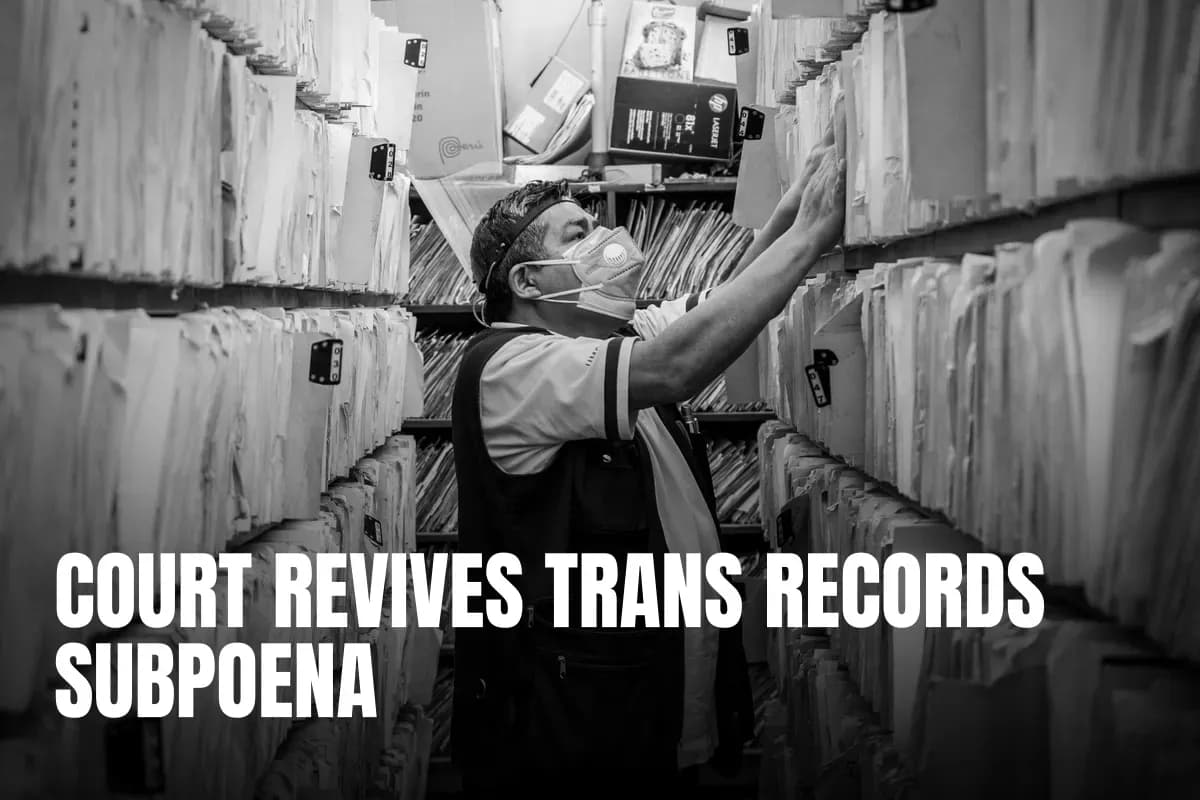
The Ninth Circuit Court of Appeals has ruled that the Department of Justice can enforce an administrative subpoena demanding the confidential medical records of transgender patients, reversing a district judge who had thrown out the demand as an abuse of federal power.
A Year of Subpoenas, A Year of Losses for DOJ
Since June 2025, the Department of Justice has issued more than 20 administrative subpoenas to hospitals and clinics across the country, demanding extensive records on transgender minors who received gender-affirming care. The department claimed authority under HIPAA's exception allowing record disclosure during investigations into federal crimes, even though its own filings describe the underlying inquiry as one into off-label prescribing, which is not itself a crime.
Until this ruling, that theory hadn't survived contact with a courtroom. Judges in Massachusetts, Pennsylvania and Colorado all quashed or sharply narrowed similar subpoenas, and a federal judge in Pennsylvania ruled that patient-specific records weren't even relevant to the investigation DOJ said it was conducting. In Washington, US District Judge Jamal Whitehead quashed the subpoena against QueerDoc last October, rejecting the government's argument outright and finding it had been "issued for a purpose other than to investigate potential violations of law."
Every patient deserves to know they can seek medical care without fear that their most personal health information will become a tool of political investigation.
Crystal Beal, QueerDoc CEO
The Ninth Circuit's Reversal
The DOJ appealed Whitehead's ruling in March, and a three-judge Ninth Circuit panel has now reversed it 2-1. Judge Carlos Bea, a George W. Bush appointee, wrote the majority opinion, joined by Judge Daniel Bress, a Trump appointee who had appeared skeptical of the DOJ's position at oral argument. Judge Richard Paez, appointed by Bill Clinton, dissented.
Bea's central argument is that Trump can direct the DOJ to pursue his policy goals, and that it isn't a district court's place to decide whether that application of subpoena power is "improper." In his view, voters, not judges, get to weigh in on a president's stated opposition to gender-affirming care. Legal observers have flagged problems with that reasoning: it treats a president's authority to state a policy preference as interchangeable with the DOJ's much narrower, statutorily limited power to issue subpoenas, which was the actual question before the court. Bea also devoted significant space to Clarence Thomas's solo concurrence in U.S. v. Skrmetti and to a contested Finnish study on gender-affirming care that neither party had raised, a detail that left even close observers of the case questioning the opinion's neutrality.
A Dissent That Pulls No Punches
Paez's dissent methodically dismantles that reasoning, pointing out that HIPAA, not presidential preference, governs whether a subpoena is lawful. He also rejected the majority's reliance on a legal presumption that government subpoenas are issued in good faith, noting that presumption only holds absent clear evidence otherwise.
It is hard to imagine clearer evidence that DOJ issued the subpoena to QueerDoc in bad faith.
Judge Richard Paez
Paez warned that the ruling requires federal courts to defer to DOJ investigations that serve the president's policy priorities, regardless of whether the underlying investigation is genuine. He closed his dissent flatly: the law doesn't let the DOJ launch sham investigations, even at a president's direction.
Why It Matters
This case has never really been about off-label prescribing. It began with the Trump administration's January 2025 executive orders seeking to end gender-affirming care for trans minors and an April 2025 memo from then-Attorney General Pam Bondi directing the DOJ to act on that goal. The subpoenas that followed were the enforcement mechanism, and until now, no court had let the DOJ get away with it.
What makes this ruling unsettling isn't limited to trans healthcare. If an agency can wield its subpoena power however it likes as long as it serves the president's stated policy goals, that logic doesn't stay contained to one issue. Today it's clinics serving trans youth; tomorrow it could be any provider, researcher or advocacy group whose work runs counter to whoever holds the White House. Some states have tried to build a wall against exactly this: Connecticut's shield law bars covered health entities from disclosing gender-affirming care records in administrative proceedings without a patient's written consent, a protection that may still conflict with this ruling in ways courts haven't resolved.
No party has yet requested a full, 29-judge en banc rehearing of the case, but legal analysts following the ruling say its reasoning, and Bea's unusual detour into policy advocacy, make that a real possibility. For now, though, a subpoena that every other court called out as harassment has cleared its first appellate hurdle, and the patients whose records are at stake have no say in the matter.
Source: LGBTQ Nation
Cover photo: Luis F Rodríguez Jiménez / Pexels