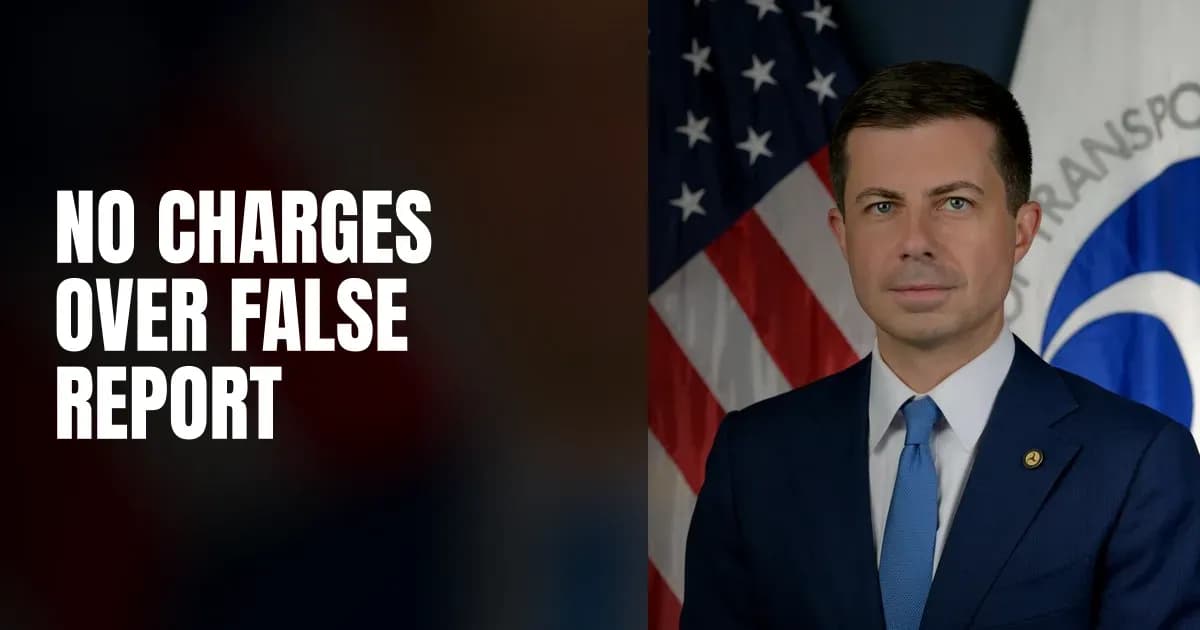
An Indiana prosecutor has decided not to file criminal charges against the woman responsible for a false child welfare complaint that led police to briefly separate Pete Buttigieg from his four-year-old twins earlier this year.
Marshall County Prosecuting Attorney E. Nelson Chipman Jr. made the call after reviewing a letter from Michigan State Police to their Indiana counterparts describing the woman, identified only as TJ, as someone with a long documented history of alcohol abuse and mental illness. According to the letter, TJ has repeatedly reported hearing voices, has claimed to identify as God, and told authorities she once shared a dinner with Barack and Michelle Obama. She was arrested during her time in Indiana for domestic battery with a blood alcohol content of .323, and separately claimed to have been sexually abused by her mother 47 years earlier in an account police described as incoherent.
Chipman wrote that given "the totality of circumstances," he could not conclude TJ was capable of forming the intent required for a criminal conviction, and that his office would not pursue charges.
What actually happened
The complaint originated with an anonymous call to police claiming Buttigieg posed a danger to his own children. The tip was routed to Indiana child welfare authorities before being passed along to police in Michigan, where the former transportation secretary lives with his husband, Chasten, and their two children. The resulting inquiry, however brief, was enough to separate Buttigieg from his twins for about 24 hours while officers investigated.
Buttigieg described the ordeal on his Substack in June, writing that he learned the caller claimed to have spoken with a woman who said she'd met him at a conference in Alabama years earlier, where he allegedly confessed to committing "unspeakable violent crimes."
I cannot describe the mix of rage and sadness that I feel at the idea that someone brought our children into this.
Pete Buttigieg
A spokesperson for Buttigieg declined to comment directly on the prosecutor's decision but told the Washington Post the situation has been "painful and infuriating" for the family, adding that they remain in contact with Michigan authorities "seeking answers and accountability for what happened."
An unresolved investigation
In July, Michigan Attorney General Dana Nessel announced her office would investigate how the complaint was handled by law enforcement, a review separate from the criminal question of whether TJ herself could be charged. It remains unclear whether that inquiry has concluded or whether it will produce any changes to how such complaints are screened before triggering a welfare check on a family.
The Washington Blade said it asked Michigan State Police whether any disciplinary action would follow, but was directed to file a public records request. That request was ultimately denied.
More Context
False reports weaponized against public figures, sometimes called swatting when police are dispatched to a home under false pretenses, have become a familiar tactic against politicians, journalists and celebrities. This case shows the same playbook can be turned against child welfare systems, using a parent's own kids as the pressure point. The prosecutor's decision hinges on a real legal threshold, not simple leniency: without provable intent, there's no crime, however devastating the fallout. But that legal reality doesn't answer the harder question of how a claim built on secondhand, uncorroborated hearsay from someone with a documented history of delusional thinking moved fast enough through the system to separate two toddlers from their father, even briefly.
Buttigieg's Substack post hinted he suspects the timing and target were not random, given his political visibility and identity as a gay father. No public evidence has confirmed that motive, and the prosecutor's letter doesn't address it at all. That gap is worth sitting with. A system that can be triggered this easily by one unwell caller is a system LGBTQ+ parents in particular have reason to worry about, since custody and parental-fitness attacks remain a favored tool against queer families.
Human Rights Campaign President Kelley Robinson framed the episode in those terms directly.
It takes an awful, hateful person to question someone's fitness as a parent just because of who they are, who they love, or in Sec. Buttigieg's case, perhaps even who he speaks out against politically.
Kelley Robinson
What's left unresolved is arguably the most uncomfortable part: the woman behind the complaint is still living in a halfway house with limited mental health treatment, and according to the Michigan State Police letter, she still has access to a computer and, to some degree, a phone. Nothing in the prosecutor's decision changes that access, meaning the same kind of complaint could happen again, against Buttigieg or anyone else.
Sources: Washington Blade, The Advocate
Cover photo: United States Department of Transportation, Public domain, via Wikimedia Commons