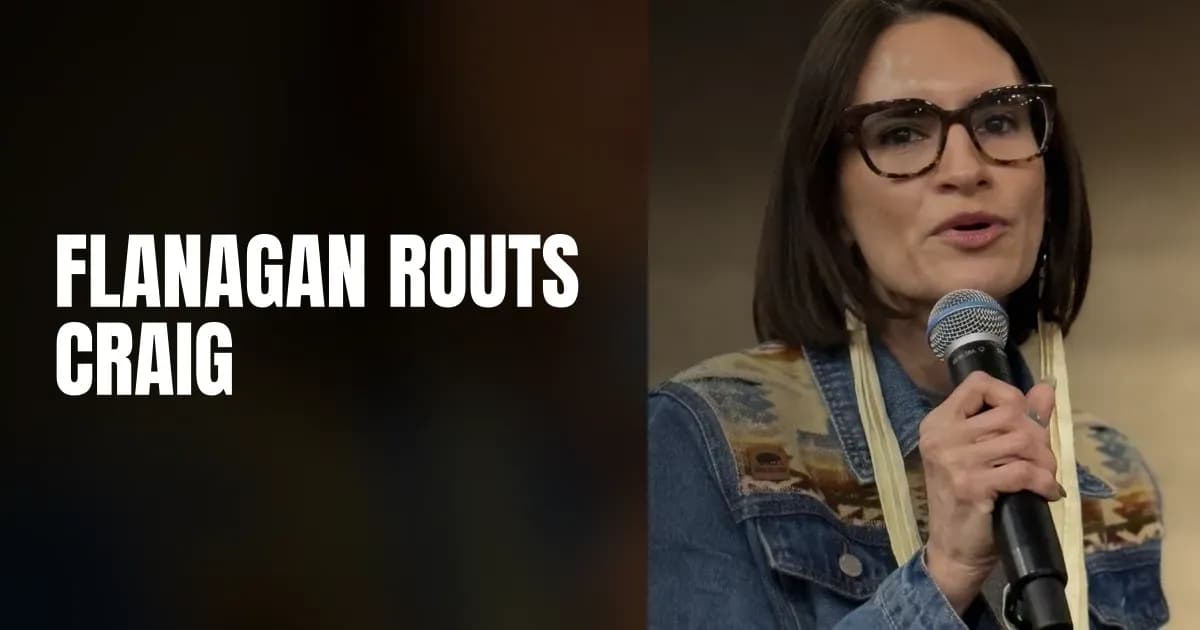
Minnesota Lt. Gov. Peggy Flanagan crushed Rep. Angie Craig in Tuesday's Democratic Senate primary, a nearly 20-point win that hands the party's nomination to the more progressive candidate and sets up a historic general election matchup this November.
A Lopsided Result
Craig entered the race with a case: she'd flipped a Republican-held Twin Cities seat in 2018 and held it through four terms, proof, she argued, that she could win statewide in a race Democrats can't afford to lose. Voters weren't convinced. Flanagan won not just the metro area but much of Greater Minnesota too, undercutting the exact argument Craig had built her campaign around. She did it while being vastly outspent: Craig and her allies put nearly $20 million into the airwaves against Flanagan's $4.7 million, according to AdImpact figures reported by NBC News.
Flanagan framed the imbalance as the whole story. "I'm running to make sure that people can afford the lives they want to live," she told NBC News' "Meet the Press Now," describing the contest as a fight of the "many versus the money." She's also called for abolishing ICE while saying she supports secure borders, and has pushed Medicare for All, positions that put her squarely in the party's Sanders-Warren lane.
The Trans Rights Litmus Test
The most consequential split in the race wasn't about electability. It was about transgender rights. The Christopher Street Project, an organization built around countering the GOP's push against trans Americans, endorsed Flanagan in part because Craig has never co-sponsored the Trans Bill of Rights, federal legislation aimed at codifying protections for transgender people that has been introduced repeatedly in Congress without passing.
That endorsement carried a pointed message: identity isn't enough. Craig would have become just the third out lesbian ever to serve in the U.S. Senate, after Wisconsin's Tammy Baldwin and California's Laphonza Butler, and is currently the first openly lesbian mother in Congress. But the Christopher Street Project made clear that representation alone doesn't guarantee a strong record on trans-specific policy, especially as those protections face escalating legislative attacks nationwide.
Craig wasn't without LGBTQ+ backing of her own. Marriage-equality plaintiff Jim Obergefell endorsed her campaign, and she drew support from the Human Rights Campaign and Equality PAC, groups that had previously praised Flanagan's own record. The split among mainstream LGBTQ+ organizations shows this wasn't a simple story of the community closing ranks behind one candidate. It was a genuine argument over priorities.
ICE, Immigration, and a Vote Craig Came to Regret
Craig's biggest liability turned out to be her vote for the Laken Riley Act, a federal law requiring detention of undocumented immigrants arrested for certain crimes, which President Trump signed shortly after taking office in January 2025. Craig later said she regretted the vote and wrote an op-ed explaining her reasoning, but the reversal didn't quiet the criticism.
The stakes became painfully real in Minnesota this year when ICE agents fatally shot two U.S. citizens, Renee Good and Alex Pretti, during an enforcement crackdown tied to the Trump administration's Operation Metro Surge. Craig later led efforts to impeach then-Homeland Security Secretary Kristi Noem, but for many primary voters, that came after the fact. Flanagan, by contrast, had already staked out a hard line, telling a Minnesota Public Radio debate audience that ICE "has to be ripped apart."
I regret giving the Trump administration an additional inch when it comes to immigration enforcement in this country.
Angie Craig
Worth Considering
It's tempting to read this purely as a progressive-versus-moderate story, and there's truth to that: Flanagan's win echoes Abdul El-Sayed's upset of Rep. Haley Stevens in Michigan's primary the week before. But the LGBTQ+ angle here deserves its own attention. This wasn't a case of a community uniformly rallying around the queer candidate. It was a case of a trans-rights organization drawing a firmer line than an out lesbian congresswoman was willing to cross, and voters rewarding that line. That's a meaningful signal about where energy in Democratic politics is right now, and it's one legacy LGBTQ+ groups should sit with.
Flanagan's own history matters too. As lieutenant governor, she and Gov. Tim Walz banned conversion therapy for minors by executive order in 2021 and worked to protect access to gender-affirming care. If she wins in November, she'd be the first Native American woman elected to the Senate and the first woman of color elected to statewide office in Minnesota, a genuinely historic outcome layered on top of an already consequential primary.
Toward November
Despite the bruising primary, Craig moved quickly to back Flanagan. "Peggy Flanagan's commitment to Minnesota and dedication to improving the lives of everyone around her is admirable, I offer her my wholehearted support," Craig wrote on X, adding that Republican nominee Michele Tafoya "is a threat to our democracy."
Tafoya, a former NFL sideline reporter turned political podcaster, won the GOP primary despite lacking her party's own endorsement, which went to a retired Navy SEAL at the state convention. She's campaigning on transgender sports participation, immigration enforcement, and corruption. Minnesota hasn't sent a Republican to the Senate since 2002, and Trump lost the state by four points in 2024, but Republicans currently hold a 53-47 Senate majority and see this as a genuine pickup opportunity. Flanagan will need to hold together the coalition that just carried her to a lopsided primary win, including the trans-rights organizations that made her their choice.
Sources: Washington Blade, Metro Weekly, LGBTQ Nation
Cover photo: Travellers & Tinkers, CC BY-SA 4.0, via Wikimedia Commons