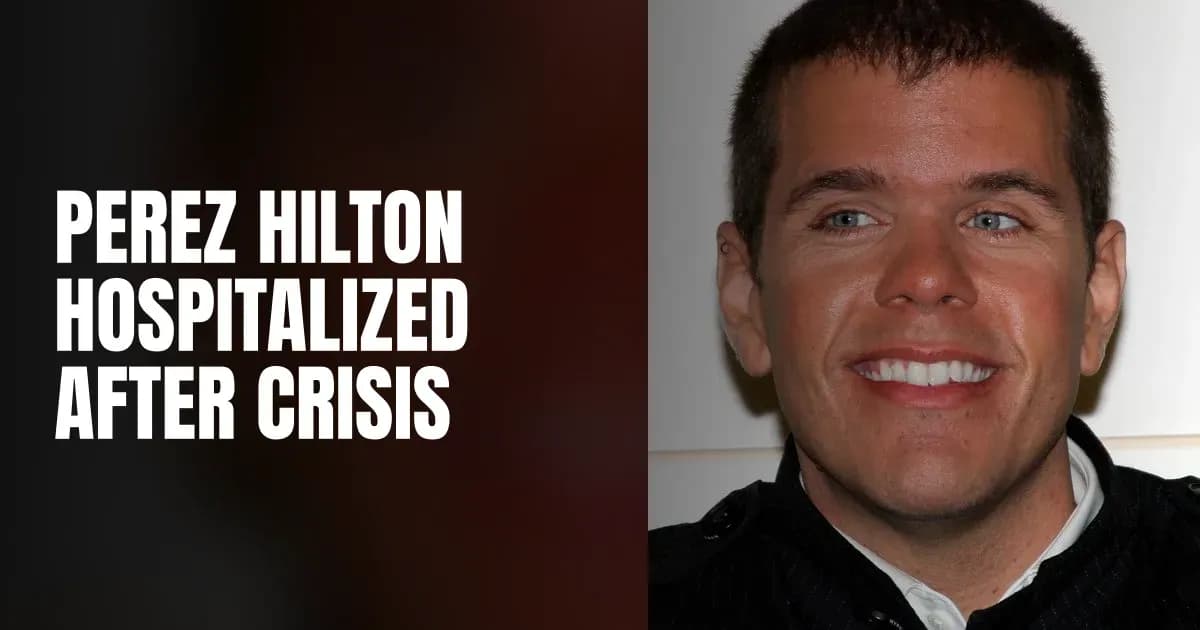
Perez Hilton, the celebrity blogger who helped define the tabloid gossip era of the 2000s, was hospitalized Tuesday night after viewers watching a TikTok livestream from his Miami-area home reported that he appeared to be harming himself.
What Happened at the Westchester Home
The Miami-Dade Sheriff's Office said it received multiple calls Tuesday night from people who had seen Hilton livestreaming what deputies described as "acts of self-harm." NBC News reported that the footage appeared to show him bleeding and holding what looked like a knife, and that some viewers begged him in the comments to share his phone number so they could call for help.
Deputies arriving at the home found him alone inside and spoke with family members on scene. Rather than forcing their way in, they chose to slow things down.
Unless there is an immediate threat to others, slowing the situation and utilizing crisis intervention techniques can reduce the likelihood of a suicide-by-cop encounter and minimize the risk of injury to the individual, deputies, and the public.
Detective Samantha A. Choon, Miami-Dade Sheriff's Office
That approach, creating time and distance rather than rushing in, is standard practice for law enforcement responding to a mental health crisis, not a sign of inaction. The department's Crisis Response Unit and licensed mental health professionals eventually helped the situation resolve while Hilton was, in the sheriff's office's words, "safely recovered" and taken by Miami-Dade Fire Rescue to a hospital for treatment.
TikTok's Response, and Where It Fell Short
A TikTok spokesperson said the platform's automated moderation systems flagged the livestream within minutes and routed it to the company's U.S. moderation team, but a moderator error delayed its removal. TikTok disputes reports that the original broadcast stayed live for a full 30 minutes, saying it was closer to 15. The company says it alerted law enforcement, shut down several follow-up livestreams within 90 seconds of their start, and banned Hilton's account for violating its Community Guidelines.
Even a short delay matters here. Graphic clips and screenshots from the stream were already circulating on social media within hours, with some users treating the footage like horror content rather than a medical emergency.
A Public Crisis, and What Comes Next
Hilton's representatives at Golden Artists Entertainment said in a statement that they had not been able to reach him directly but that his health and his family's wellbeing were their "primary concern." His family later posted its own update, saying Hilton is "receiving medical care" and, notably, "is able to communicate, which has given our family hope."
This is not Hilton's first serious health scare this year. He spent 21 days hospitalized in March with severe sepsis, then underwent a thrombectomy in April to remove a blood clot after being diagnosed with deep vein thrombosis. He moved from Las Vegas to the Miami area in June.
Why "Attention-Seeking" Is the Wrong Frame
Hilton's history as a blogger who built a career on outing people and mining other celebrities' private pain has understandably shaped how some people are reacting to his own crisis. But a mental health emergency doesn't stop being one because the person having it has hurt others before.
There's this immediate feeling of that seems attention seeking, that seems unnecessary to do it in that way, live-streamed when you know others will be watching. And when someone is in distress, that's the way it manifests for some individuals. It doesn't mean that their behavior is any less serious.
Dr. Christine Yu Moutier, American Foundation for Suicide Prevention
Moutier, the organization's chief medical officer, said self-harm can happen with or without an intention to die, and that strangers watching a clip have no way to determine intent. She described a phenomenon called thought constriction, an acute psychological state in which overwhelming distress can temporarily crowd out someone's ability to see options or reach for coping tools they'd normally use. Those states, she said, usually pass in "moments to minutes," which is exactly why de-escalation and time matter so much in the moment.
The Case for Not Sharing the Video
Hilton's hospitalization ended the emergency at his home. It didn't end the risk created by the recording itself. A systematic review of 15 studies published in the Journal of Child Psychology and Psychiatry found harmful effects in every single study examining exposure to self-harm content online, including increased distress, normalization, and stronger urges toward similar behavior.
Moutier pointed to that Vienna example, from the 1980s, as evidence that how a crisis is covered actually shapes outcomes for a vulnerable subset of the audience, not just public perception of the person involved. Coverage heavy on graphic detail and personal specifics can do harm; coverage built around help, hope, and healing can push people toward getting support instead.
MQ's Take
We're not going to describe what's in that video, and we'd ask you not to go looking for it. Hilton spent two decades building a brand on other people's worst moments, and it's fair to hold that record in mind. It's also true that the video circulating right now isn't content, it's a person in crisis, and treating it as entertainment risks real harm to anyone else watching who's struggling too. Those two facts can sit side by side without canceling each other out.
If you or someone you know is in crisis, the 988 Suicide and Crisis Lifeline is available by call or text, day or night.
Sources: them., Metro Weekly, PinkNews, The Advocate
Cover photo: Paparazzo Presents, CC BY-SA 3.0, via Wikimedia Commons