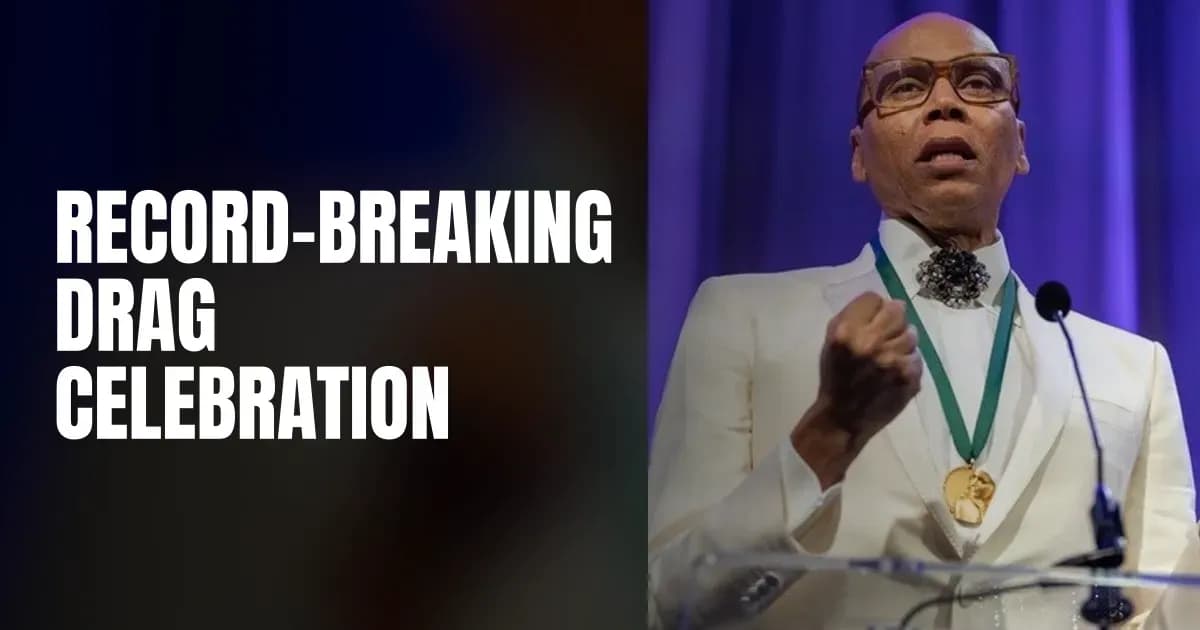
On July 11, drag fans and performers in Calgary made history: 7,423 people gathered at Cowboys Park for "Drag Me to Cowboys," setting the Guinness World Record for the largest attendance at a drag artists' performance ever. Headlined by RuPaul and featuring Drag Race legends Sasha Velour, Sasha Colby, Roxxxy Andrews, and Coco Montrese, the sold-out event at Calgary's annual Cowboys Music Festival became a raucous, joyful assertion of queer visibility in a moment when Canada's LGBTQ+ community faces real political pressure.
A Celebration on Stage and in the Streets
When Guinness World Records adjudicators took the stage to announce the record, the crowd erupted. RuPaul then arrived and lip-synced to Queen's "We Are the Champions," transforming the confirmation into a full victory lap. The visual was deliberate and potent: drag as triumph, queerness as something worth celebrating in numbers, in front of witnesses, in the official ledger.
The event has grown into one of the Cowboys Music Festival's flagship attractions-an unlikely pairing of country music and drag that doesn't have an obvious American equivalent. Farrah Nuff, the Calgary drag artist who hosts "Drag Me to Cowboys," told organizers she wanted to mark the festival's 30-year milestone with a record attempt to prove the community was "more alive than ever." Festival organizers told Guinness they aimed to "make this a title worth fighting for in the future, by expanding the size and impact of drag performances worldwide."
For many attendees, simply showing up was itself political. Karla Marx, a Calgary drag performer who participated in the show, spoke to the deeper meaning. "On the biggest stages and in the biggest celebrations in Canada and Alberta," she said, "queerness is absolutely a vibrant part of our communities."
A Record Shadowed by Real Hostility
Yet the euphoria was undercut by a stark reminder of the work still ahead. Just hours before the show, three performers were left stranded on a curb when their ride-share driver spotted their drag outfits and sped away without them.
Drag is political. It always has been political and it always will be political. As soon as I put on my outfit, my hair is done and I walk out there, that's a political statement.
Farrah Nuff
Farrah Nuff used the moment to articulate something many in the community feel viscerally. "The political statement is: 'I'm here, I'm queer, and you're just going to have to deal with it.'" That defiance wasn't performative posturing-it reflected the climate in Alberta, where conservative provincial lawmakers have restricted LGBTQ+ visibility in schools and public life.
Drag as Resistance in a Narrowing Space
Alberta's Education Amendment Act, which took effect last September, requires parental consent for schools to use a different name or pronouns for students under 16. It also mandates opt-in provisions for any instruction touching on gender identity, sexual orientation, or human sexuality. The impact has been immediate and damaging.
"We're definitely seeing a lack of visibility," said Mitchel Bowers, executive director of Wood Buffalo Pride in northern Alberta, who attended the event wearing a shirt that read "Make Alberta Gay Again." "We're seeing less youth being able to participate and we're seeing an increase in bullying. The impacts of this current government are directly harming queer people in our communities." Bowers was present to witness something the government's policies work to suppress: a massive, visible, unapologetic queer gathering.
The event was also a rare moment of political alignment. Calgary Mayor Jeromy Farkas opened the show with a simple and pointed message: "You walk in here. No matter who you love, you belong here. You can't say that about every place, but you can say that about Calgary, and you can say that about Cowboys." He then delivered his own blunt benediction: "F**k the haters."
Why This Record Matters Right Now
Guinness World Records, as an institution, doesn't typically traffic in political symbolism. But this one does, whether by design or happenstance. A number-7,423-now sits in the official record books as evidence of collective queer joy and solidarity. It's a number that can be cited, that can inspire future organizers to aim higher, that proves there is appetite for drag when given a legitimate stage.
For an LGBTQ+ community in Canada facing legislative erasure and social hostility, the record is less about drag supremacy than about survival and refusal. The line stretched around the venue. The crowd erupted when RuPaul arrived. The official record was set. And the statement was clear: you can try to make us smaller, quieter, less visible-but we will find the biggest stage available and fill it.
Sources: LGBTQ Nation, PinkNews
Cover photo: Government of California, Public domain, via Wikimedia Commons