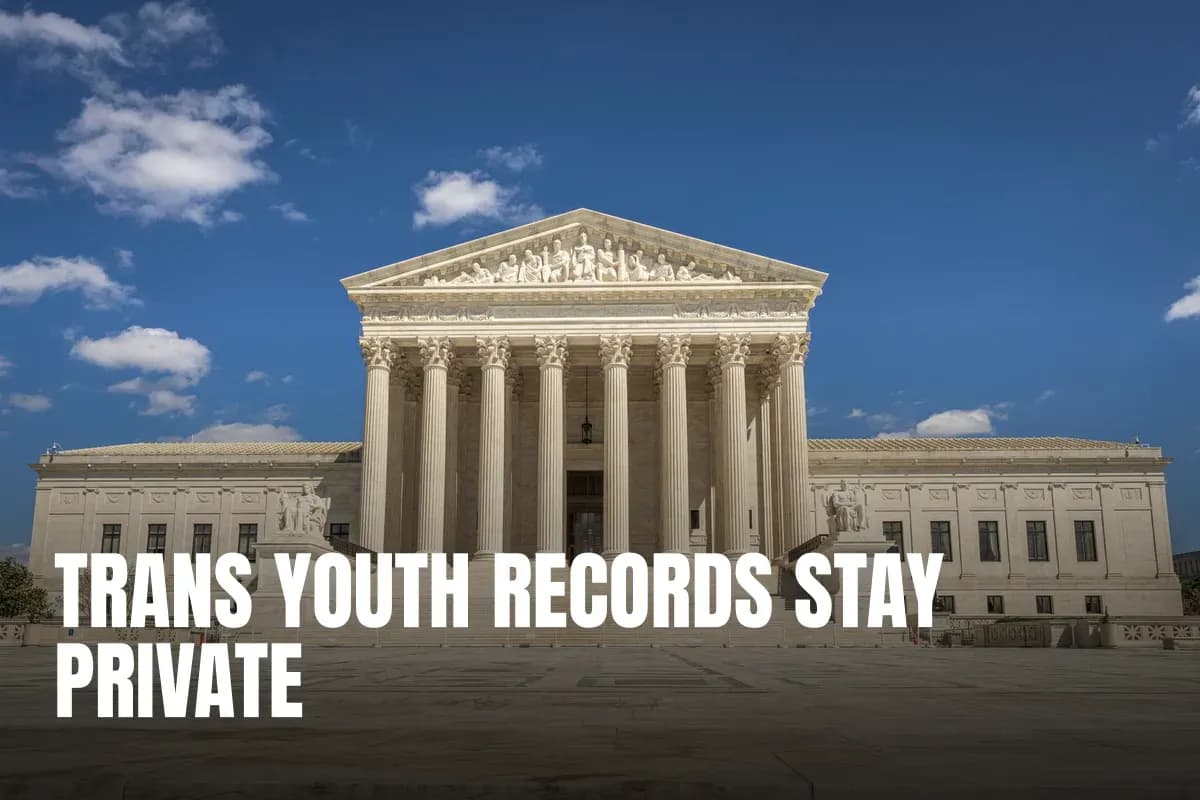
A federal appeals court has once again told the Trump administration it cannot pry loose the private medical files of transgender teenagers who sought care in New York City.
What the Court Decided
The U.S. Court of Appeals for the Second Circuit issued a one-sentence order denying the Justice Department's bid to lift a preliminary injunction while it appeals. That injunction, issued July 6 by U.S. District Judge Katherine Polk Failla, built on a temporary restraining order she granted in June. The practical effect: NYU Langone Health does not have to turn over the records, at least for now.
The subpoena at the center of the fight came from federal prosecutors in the Northern District of Texas, operating under the authority of a grand jury in Fort Worth. It demanded 17 broad categories of documents covering gender-affirming care provided between January 2020 and May 2026, including material that would identify individual patients and detail their diagnoses and treatment. NYU Langone made the subpoena public; it referred to gender-affirming care using the loaded phrase "sex-rejecting procedures." Mount Sinai reportedly received a similar demand, though the specifics remain unclear.
The government cannot weaponize the legal system and the use of subpoenas to collect the most private medical information of transgender young people and their families, in violation of the right to privacy guaranteed by our Constitution.
Omar Gonzalez-Pagan, Lambda Legal
A Year-Long Campaign, Mostly Losing
This case is one thread in a much bigger effort. Since last June, the DOJ has issued more than 20 administrative subpoenas to hospitals nationwide seeking records on trans minors' care, escalating in some cases to grand jury subpoenas, a more aggressive tool typically reserved for criminal investigations. At least eight federal district courts have blocked these attempts, with one judge calling the DOJ's justification a "smokescreen" and another finding the department "issued the subpoena first and searched for a justification second."
The DOJ has argued HIPAA permits it to seek these records as part of an investigation into off-label prescribing, even though prescribing medication off-label isn't itself a crime. Judges in Maryland and California have already rejected similar demands, and the department voluntarily dropped its appeal in Pennsylvania rather than keep fighting for UPMC Children's Hospital of Pittsburgh records. The picture isn't uniformly favorable to trans families, though: the Ninth Circuit recently upheld a DOJ subpoena elsewhere, underscoring how unsettled and circuit-dependent this fight remains.
The Toll on Care
Even when hospitals win in court, many aren't waiting to see how the broader legal fight ends. Dozens of hospitals around the country have paused or ended transgender health services for minors, citing legal pressure. NYU Langone is one of them: despite refusing to hand over patient records, the hospital system stopped providing gender-affirming care to minors after the administration threatened to strip it of federal funding, including Medicare and Medicaid dollars.
That's the quieter cost of this campaign. The subpoenas keep losing in court, but the threat of losing federal funding is already reshaping what care is available, regardless of how any single case turns out.
Our laws recognize that everyone deserves basic privacy protections for their sensitive medical information, and we will continue to fight for the rights of transgender New Yorkers and their families.
Bobby Hodgson, New York Civil Liberties Union
Why It Matters
Medical privacy isn't an abstract principle here. These are files that could identify specific teenagers and families, handed to a Justice Department that has made no secret of its hostility toward gender-affirming care. Fifteen state attorneys general, led by California's Rob Bonta, have already filed an amicus brief opposing the DOJ's subpoena strategy in related cases, a sign this fight is spreading well beyond New York courtrooms.
For now, the families who sought care at NYU Langone can breathe a little easier. But with courts split across circuits and hospitals already retreating from care under pressure, this fight is nowhere near finished.
Sources: them., The Advocate
Cover photo: Mark Stebnicki / Pexels