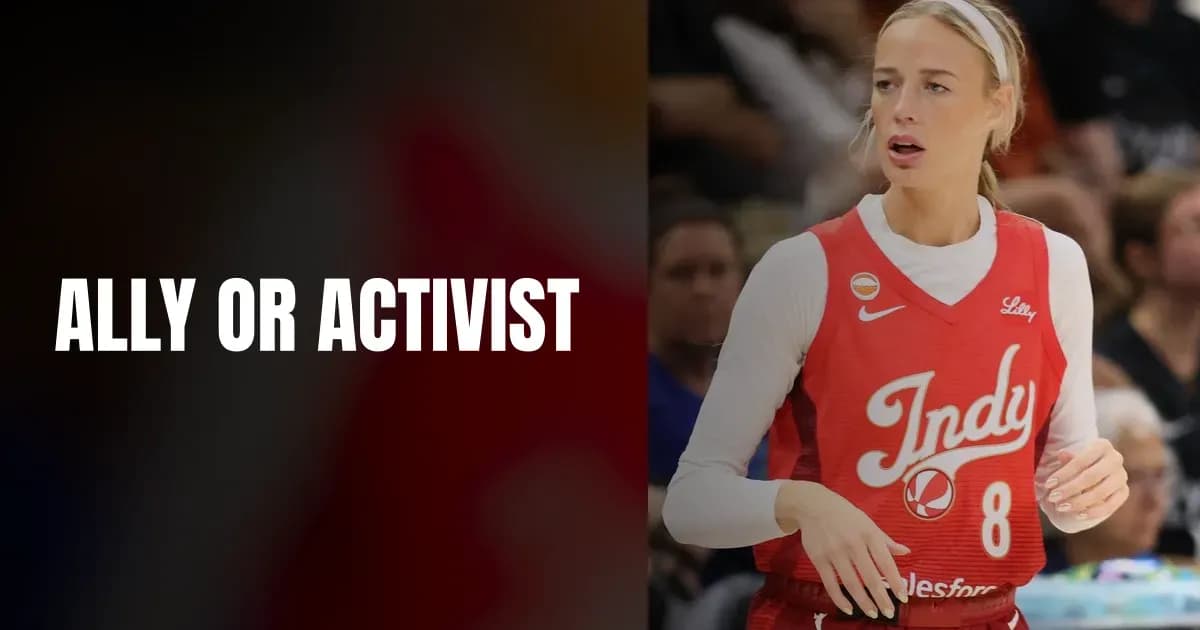
Sophie Cunningham's remarks about trans athletes sparked a national firestorm, but her actions at Sunday's Indiana Fever game may have ended any pretense that she holds a carefully calibrated middle ground on the issue. The WNBA star posed for photographs with anti-trans activist Riley Gaines and wore her messaging, effectively joining forces with the far-right figures who view the sports debate as a vehicle for dismantling trans rights entirely.
From controversy to alignment
Cunningham's July ESPN interview already signaled a hardening stance. She said banning trans women from sports is "common sense" and insisted she wanted to "protect young girls in a locker room, or young girls in sport who shouldn't have to go against biological men." She claimed she harbors no hate toward trans people, only concern for cisgender girls. That framing left room for a nuanced position, one that could theoretically acknowledge both trans athletes and distinct competitive contexts.
The Sunday game changed that calculus. Cunningham was photographed beaming alongside Gaines, who wore a shirt from XX-XY Athletics, the anti-trans apparel brand founded by former Levi's executive and gymnast Jennifer Sey. The two posed together, and Cunningham held up Gaines' handmade sign reading, "Sophie, Thank You. -A Girl Mom." The gesture erased any lingering distance between Cunningham's stated position and Gaines' explicit ideology.
Who Riley Gaines really is
Gaines emerged as a far-right media darling after she tied for 5th place with trans swimmer Lia Thomas in 2022. Over the years, her positions have evolved from objections to Thomas' participation into something far more sweeping. Last year, she told conservative commentator Charlie Kirk that gender identity itself is a threat to humanity: "This is the most basic of truths: man and woman. It's the sheer essence of humanity, a truth we have never struggled to understand in the nearly 250 years we've been established as a country." She has also claimed that trans advocacy is "an attempt to normalize pedophilia."
The gender ideology movement is a house of cards, and I believe it's lying on that sports issue. This will be the card that makes all of it crumble.
Riley Gaines, to the New York Times
Perhaps most revealing is Gaines' own admission to the New York Times that sports is a strategic opening. "The gender ideology movement is a house of cards, and I believe it's lying on that sports issue," she said. "This will be the card that makes all of it crumble." Her alignment with Cunningham is not a coincidence but a deliberate cultivation of a new face for anti-trans activism.
The game and the message
Sunday's Fever-Lynx matchup became a flash point for the wider battle. The crowd booed Cunningham repeatedly. Trans rights supporters filled the stands with signs and shirts declaring solidarity with trans athletes and trans youth. The Lynx defeated the Fever 108-100, with Cunningham scoring just three points.
The visual contrast could hardly have been sharper. While Cunningham posed with Gaines, Minnesota Lynx head coach Cheryl Reeve took the court wearing a "Trans Kids Belong" shirt. In a post-game interview, Reeve directly challenged the framing that has animated Cunningham's remarks.
The narrative that I think is problematic is to suggest that transgender athletes are the biggest problem in women's sports. We need to protect trans kids. To me, it's a human rights issue.
Cheryl Reeve, Lynx head coach
"The narrative that I think is problematic is to suggest that transgender athletes are the biggest problem in women's sports," Reeve told reporters. She framed trans youth protection as a human rights issue, not an ideological stance, and called for nuance in how sports policies are developed. "Common sense people get together, and you find common ground to find a way to be inclusive," she said.
Reeve also spoke directly with Cunningham after the game, describing the conversation as cordial and noting they share a desire to educate. But the shirt, the words, and the public stance sent an unmistakable message: there is another way to think about this issue, one rooted in inclusion rather than exclusion.
The bigger picture
What unfolded at Sunday's game is part of a larger pattern. The ultra-right has openly acknowledged that trans athletes in sports is a wedge issue designed to soften public resistance to broader attacks on trans rights. Once the door opens to debating whether trans women belong in sports, the strategy goes, it becomes easier to restrict access to healthcare, limit legal recognition, and roll back protections. Gaines' own words confirm this: sports is the card meant to make the entire "house" fall.
Cunningham's alignment with Gaines and Sey amounts to an endorsement of this strategy, whether she has fully thought through those implications or not. Commentary by journalist Howard Bryant in The Guardian suggested a more cynical read: that Cunningham is "cashing in" on controversy to build a platform and income stream beyond her basketball career. "Her whiteness sells," Bryant wrote. "Add transphobia to her portfolio, and the result is a star."
Where the WNBA stands
The league itself has a history of supporting trans rights. In 2021, the Women's National Basketball Players Association filed an amicus brief in federal court to protect transgender student athletes. "The players believe in the power of sport to fundamentally change the lives of all young people," the association said then. "We want to send an unequivocal message to trans and nonbinary youth in sports: we see you, we are an ally and we will fight for you."
Caitlin Clark, the Fever's star point guard and one of the league's most respected voices, deflected questions about Cunningham on Sunday, saying the focus should be on basketball. But her silence stood in contrast to Reeve's vocal support for trans youth and the broader LGBTQ community presence in the stands.
Cunningham's actions have opened a chasm. On one side: activists like Gaines who view trans rights as a house of cards to be toppled, and Cunningham, who has now stepped openly into their camp. On the other: coaches, players, and fans for whom the WNBA's values include protecting and celebrating trans athletes and youth. The game on Sunday revealed which team Cunningham has chosen.
Sources: LGBTQ Nation, Erin in the Morning
Cover photo: John Mac, CC BY-SA 4.0, via Wikimedia Commons