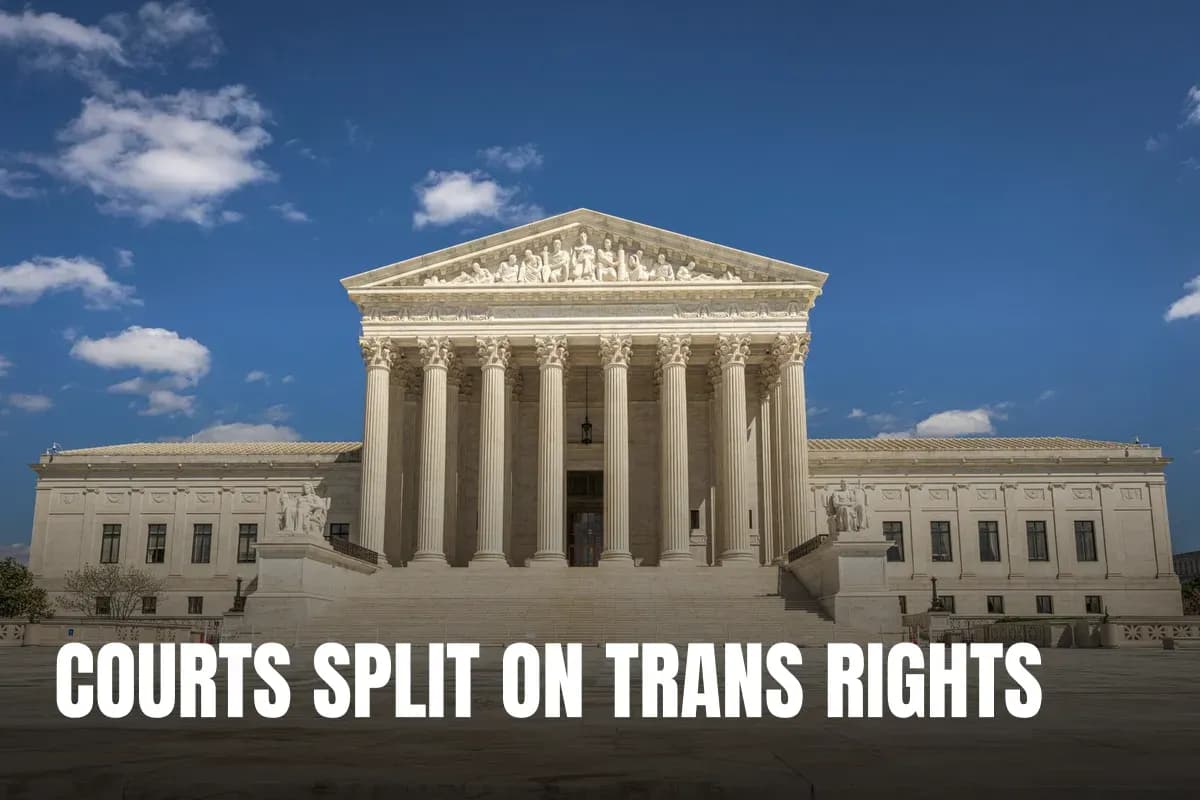
This week showed just how split the courts are on transgender rights under the second Trump administration: one judge kept insurance coverage for gender-affirming care intact, another let federal prosecutors subpoena trans patients' medical records for the first time, and halfway around the world, Russia forced its largest LGBTQ+ organization out of existence.
A Win, For Now, on ACA Coverage
Twenty-one states had sued the Department of Health and Human Services over a 2025 rule allowing individual and small-group plans sold on the Obamacare marketplaces to exclude gender-affirming care for trans people of any age. A federal judge sided with the states this week and blocked the rule, keeping coverage in place that advocates say is lifesaving for the people who depend on it.
The First Crack in Medical Privacy
A three-judge panel on the Ninth Circuit US Court of Appeals went the other way in a separate case, ruling that the Justice Department could subpoena a queer health clinic's medical records. The majority reasoned that the administration can "exercise its statutory authority in a manner that aligns with [the president's] broader policy goals," including ending gender-affirming care for trans youth, even though Congress has never passed a law banning it.
That's a real reversal. Every other court to hear a challenge to these subpoenas, including one involving the University of Pittsburgh Medical Center that the DOJ recently abandoned rather than keep fighting, has quashed them, with one judge calling the demands "motivated only by bad faith." The chilling effect is already visible: threats to cut funding from gender-affirming care providers pushed NYU Langone to close its program for trans youth earlier this year. If the split holds, it could be the kind of conflict the Supreme Court eventually has to resolve.
Russia Shutters Its Largest LGBTQ+ Organization
Thousands of miles away, the Russian LGBT Network announced it was closing after authorities designated it a "terrorist" group, one of nine LGBTQ+ organizations branded "extremist" in Russia this year. The label exposes anyone associated with the group to potential prosecution, and the network said it had no way to guarantee people's safety while operating under that threat.
"We made this decision after carefully assessing the risks. People's safety comes first."
Russian LGBT Network
Why It Matters
These stories belong together because they show how uneven the fight actually is right now. The ACA ruling matters enormously for the people who buy their own insurance and would have lost coverage overnight. But the Ninth Circuit's decision may matter more in the long run: once a court accepts that federal agencies can chase a president's policy goals through subpoenas instead of legislation, that reasoning rarely stays confined to one clinic or one circuit.
Russia offers a preview of where that logic ends up when there's no independent judiciary left to push back. The US courts are still fighting this out case by case, which is exhausting to watch, but it's also the point: as long as some judges are willing to say no, there's still a check on how far these efforts can go.
Source: LGBTQ Nation