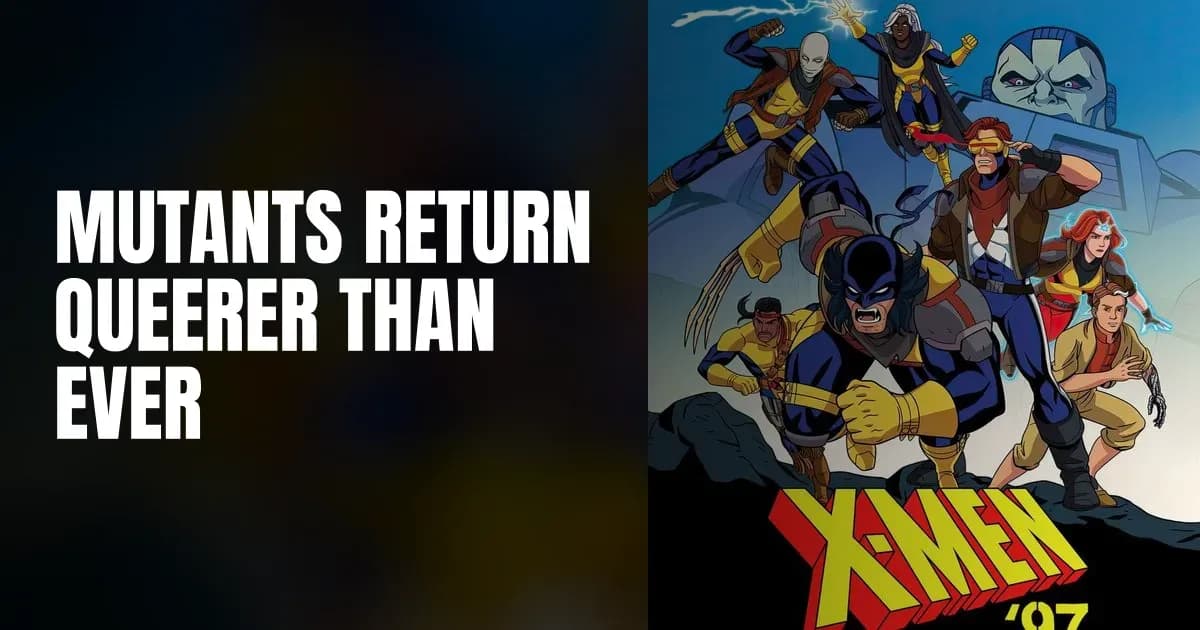
The mutants are back, and they're scattered across time itself. Marvel Animation's Primetime Emmy-nominated revival X-Men '97 returns for season 2 on Disney+ on July 1 with its first three episodes, picking up from a mind-bending cliffhanger that left the team fractured across the ancient past, present day, and a distant future. It's a wild setup, but for the voice actors bringing these characters to life, the emotional terrain is even more disorienting than the timeline jumps.
A second season born from chaos
JP Karliak, who voices the shapeshifter Morph, laughs when describing the recording process. "Because we were working on Season 1 and 2 at the same time, and then 2 and 3 at the same, and out of order with different episodes... I've lost track!" he says. The result is a sophomore season that pushes its ensemble into unfamiliar emotional spaces, even as the plot scatters them across dimensions and time periods.
Lenore Zann, who has voiced Rogue since the original X-Men: The Animated Series debuted in 1992, teases significant new material for her character. "I'll just say that I love where Rogue is going. I love her hero's journey," she says. "She will continue to try and find justice for what has happened to Remy [Gambit] and for a whole genocide. And that will take her to some dark places."
Grief and survivor's guilt shape Rogue's journey
The weight of Genosha's destruction, the mutant sanctuary's devastating attack in season 1, still defines Rogue. She didn't merely lose a teammate; she watched Gambit, the man she loved, die in her arms. Season 2 opens with those wounds raw and unhealed, and Zann hints at a turning point coming in the fourth episode that could fundamentally shatter Rogue's fragile emotional state.
Rogue is dealing with a whole survivor's guilt already. When you witness a genocide up close and personal, and you lose people that you love, obviously it's going to affect you deeply.
Lenore Zann
"She's still grieving," Zann says carefully, mindful of Marvel's secrecy. "And that is going to continue and it's going to intensify before it gets any better." It's a portrait of loss that refuses easy resolution, acknowledging that trauma compounds over time, especially when compounded by the guilt of surviving what others didn't.
Morph's transformation goes beyond shape-shifting
If Rogue is navigating grief, Morph is on an entirely different inner odyssey. In the original series, the character appeared briefly at the very end. In this revival, Morph has spent years away from the team, wrestling with PTSD and identity questions. Season 1 became partly about finding solid ground again, using humor as both defense and bridge back to connection.
But season 1's finale signaled a seismic shift. In a vulnerable moment, Morph transformed into Jean Grey to confess romantic feelings for Wolverine, a scene that electrified the fanbase and hinted at emotional depths the character is still exploring. "I think you're going to see some emotions Morph has yet to explore in this season," Karliak teases. "More than just the ba-dum tss!"
Nonbinary representation that simply exists
What makes Morph's arc especially significant for LGBTQ+ audiences is that Marvel has made the character explicitly nonbinary in this iteration, a watershed moment for the franchise. Yet the show doesn't halt its narrative to announce this identity or deliver a treatise on gender. Instead, it lets Morph's identity simply exist as an unremarkable fact of life in the X-Mansion.
"Even though we never really talk about it in the show, other than Rogue using 'they' and 'them' pronouns for Morph at one point, we really don't address it too much," Karliak explains. "And of course, the 'will they, won't they' relationship with Wolverine, but it still hits on such a level... I certainly get trans and nonbinary people who feel so seen and feel so hopeful, during this exceedingly dark time, when they see a queer superhero like Morph."
I feel like our identities are so linked together. When people say how they feel seen, I'm feeling it too. We're in the same boat of feeling that representation through Morph.
JP Karliak
For Karliak, the line between actor and character blurs entirely. He doesn't employ a special voice or affectation for Morph, the character simply is, and that authenticity carries weight for audiences encountering themselves reflected on screen.
The enduring metaphor that keeps resonating
Since Stan Lee and Jack Kirby created the X-Men in 1963, the mutants have functioned as a standing metaphor for any marginalized community: individuals hated and feared by a world they're bound to protect, finding sanctuary not in acceptance from above, but in each other. For LGBTQ+ people, that metaphor has always cut deep.
The X-Men represent the concept of chosen family, those vital, life-saving networks of love and safety that queer people construct when biological or social families reject them. Rogue's specific curse, her inability to touch another person without absorbing their life force, becomes especially resonant for queer audiences.
"I'm often hearing from the LGBTQ community who come up to me that they relate so much to her because of her inability to be able to touch somebody that she loves," Zann says. "And her desire to look at people who are walking along the streets, holding hands, kissing in a park, whatever, all the things that 'normal' people can do. But the LGBTQ community felt that they were held back for many, many years. Then things started to get better. And now, things are going back the opposite direction again."
Why It Matters
The timing of X-Men '97's return feels almost too pointed. In a cultural moment when LGBTQ+ people face renewed legal and social pressures, a show that centers chosen family and explicitly refuses shame carries particular power. The mutants aren't fighting for acceptance into a hostile world, they're building meaning and dignity among themselves, which may be the most radical message the franchise has ever offered.
Zann frames her responsibility plainly: "It's been a real honor to play a character in a show that is really all about representation and the ability for a whole bunch of misfit kids to come together and learn to accept themselves for who they are and learn to accept each other without shame or blame. And to not only do that, but to also try and fight for the right to exist in a world that hates and fears us."
For the LGBTQ+ fans who've kept the X-Men alive in their hearts since 1992, season 2 promises not escape, but something far more valuable: the recognition that their struggles, their chosen families, and their refusal to be broken are worth telling in serious, complex, deeply human ways.
Poster via The Movie Database (TMDB)