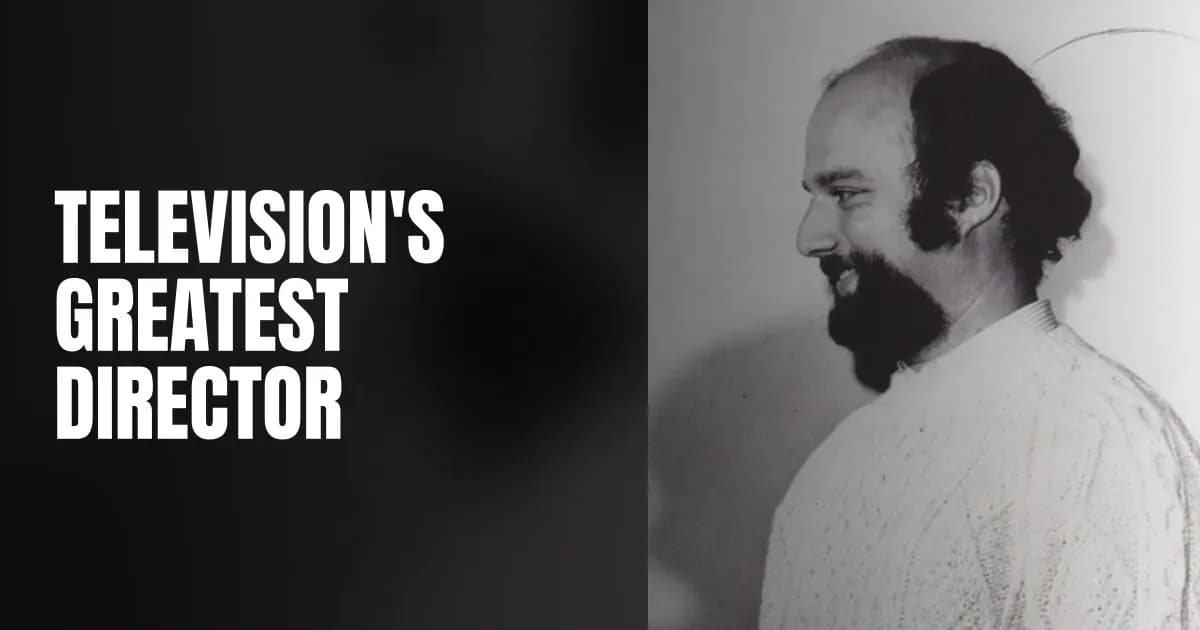
James Burrows, the prolific television director whose steady hand shaped some of the medium's most beloved comedies and whose career spanned nearly six decades, died on June 19. He was 94.
An Architect of Modern Television
If television directing is an art form, Burrows was its master craftsman. Over a career that began in the late 1960s, he directed more than 1,200 episodes of television and over 50 pilots, most of which became series. This is not a distinction easily understated: television directors are the invisible architects of viewing habits, and Burrows' invisible hand guided some of the most-watched comedies in American history.
He co-created and directed "Cheers," the show that defined the 1980s and early '90s. He was instrumental in launching "Taxi," "Frasier," "Wings," "3rd Rock from the Sun," "Dharma & Greg," "Two and a Half Men," and "The Big Bang Theory." He directed multiple seasons of "Friends" and the entirety of the "Will & Grace" revival. His ability to develop pilots that became cultural touchstones was almost supernatural: he had a gift for identifying chemistry among casts, then orchestrating that chemistry into ensemble dynamics that audiences returned to week after week.
Burrows won 11 Emmy Awards across his career, earned 24 Emmy nominations over 26 years, and received five Directors Guild of America Awards. In 2015, he received the inaugural DGA Lifetime Achievement Award for Television Direction-a recognition that felt less like an accolade and more like television finally acknowledging what it had always known: that Burrows had shaped the industry's DNA.
The Unsung Hero of LGBTQ Television
What set Burrows apart, especially for the LGBTQ community, was his deliberate commitment to telling queer stories during eras when mainstream television largely didn't. "Will & Grace," which premiered in 1998 and ran for eight seasons before its 2018 revival, was a watershed moment: a sitcom centered on a gay man and a gay woman, their families, and their lives, treated with the same comedic warmth and narrative weight as any other show on NBC. Burrows didn't just direct it-he shepherded it, every single episode of the revival included.
Actor Tim Bagley, who worked with Burrows across more than 40 years-from "Cheers" to HBO's "The Comeback"-credited the director's "empathy for LGBTQ people" with revolutionizing television's approach to queer representation. That empathy wasn't performative. As recently as 2025, Burrows directed the full run of "Mid-Century Modern," an HBO Max series starring Nathan Lane and Matt Bomer, two openly gay actors, in leading roles. He also helmed the unaired "Absolutely Fabulous" pilot alongside Kathryn Hahn, Kristen Johnston, and Zosia Mamet.
"Life is too short to deal with obnoxious leads. So as long as the writing is good and the cast is fun, I'm going to enjoy the experience."
James Burrows
Throughout his career, Burrows worked with an array of queer cultural icons and allies: Betty White, Stockard Channing, Jennifer Coolidge, and others. He approached these collaborations not as a director checking a box but as someone who understood that television's power lay in its intimacy-the ability to invite people into living rooms and ask them to care about characters they might otherwise never encounter.
The Philosophy Behind the Magic
Burrows' secret wasn't smoke and mirrors. In interviews, he was remarkably candid about his method. He insisted on what he called a "fun clause" in his contracts: if the writing was strong and the cast gelled, he would commit fully. He believed his job was to "mold [the cast] into an ensemble," to help them understand their characters' relationships so deeply that the chemistry became real. This wasn't method acting or elaborate technique-it was fundamentals executed with precision and care.
He had an almost anthropological understanding of how ensembles work. "They did round into a group of people who loved each other," he said of the "Cheers" cast, and that wasn't metaphorical. The warmth viewers felt was built on set by a director who believed that comedy emerged from genuine connection, not forced artifice.
Why It Matters
Burrows' death marks the end of an era in television-one in which a single director could accumulate enough credits and respect to shape the medium's entire sensibility. The logistics of modern streaming and episode production make his kind of sustained artistic authority nearly impossible today.
But his legacy extends beyond Emmy counts. For LGBTQ audiences, especially those who came of age in the '90s and 2000s, Burrows directed the television that made them feel seen. "Will & Grace" wasn't revolutionary because it was edgy or confrontational; it was revolutionary because it was warm, funny, and treated queer people as the full humans they are. That gentleness, that refusal to make LGBTQ identity the punchline or the crisis, was Burrows' contribution to American culture.
When asked in a 2003 Television Academy interview how he wanted to be remembered, he answered simply: "That every night forever you can tune in somewhere, and there'll be a show I did." That wish has already been granted many times over. His shows are in syndication, on streaming platforms, and in the muscle memory of viewers who grew up with them. In that sense, Burrows never really left television-he just became part of its infrastructure.
He is survived by his wife, Debbie, four daughters, and seven grandchildren.
Sources: Washington Blade, Out, The Advocate
Cover photo: United Press International, Public domain, via Wikimedia Commons