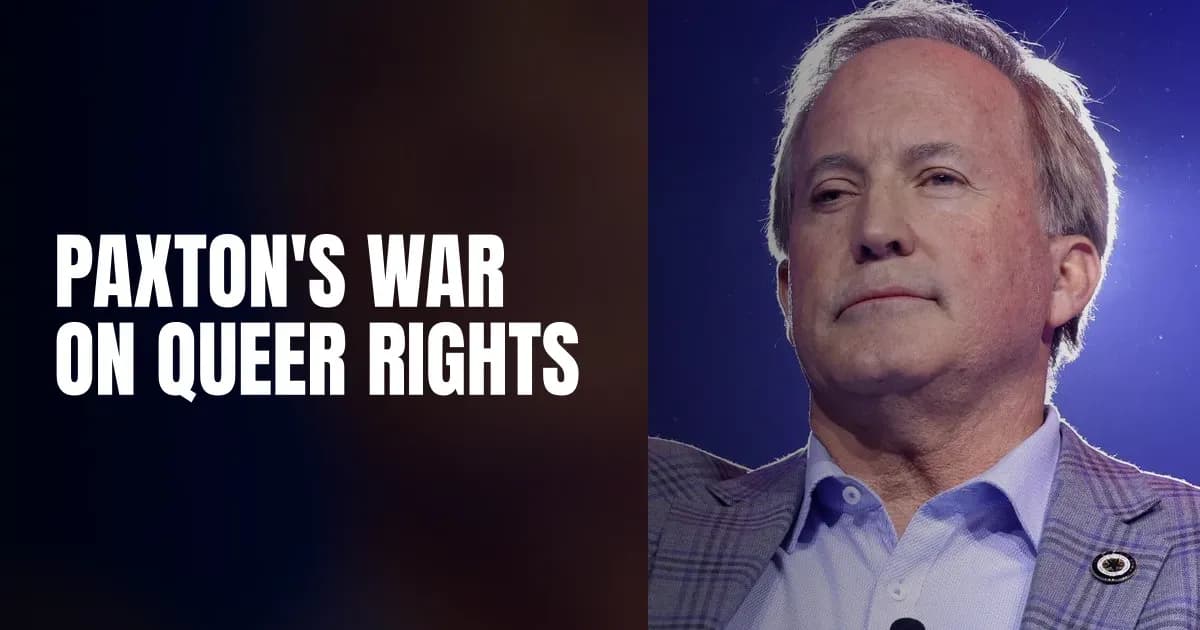
Texas Attorney General Ken Paxton is taking his fight against LGBTQ+ rights national. Now running for U.S. Senate, Paxton has spent over a decade weaponizing his office to target the state's queer communities, with particular ferocity aimed at transgender people, minors seeking gender-affirming care, and institutions that support them.
From State Court to National Stage
Paxton's political rise has been inseparable from his anti-LGBTQ agenda. Elected Texas Attorney General in 2014, he has used the office not just to enforce existing law but to expand the state's legal apparatus for policing queer identity and care. Working closely with Governor Greg Abbott, Paxton has launched investigation after investigation, issued controversial legal opinions, and pursued settlements designed to make examples of providers and institutions.
His 2024 litigation against two Texas doctors for providing gender-affirming care to minors signaled a willingness to prosecute individual medical professionals. But his most aggressive move came in May of the same year, when he settled litigation against Children's Medical Center of Dallas by forcing a $10 million payment, the firing and blacklisting of five doctors, and the creation of a "Detransition Clinic" framed as a way to reverse what he termed "damage" from transition care.
Paxton has called LGBTQ+ people and their allies "deceptive sexual propagandists and predators."
The Gender-Affirming Care Campaign
Paxton's assault on transgender healthcare has been his most sustained legal project. In February 2022, he issued a non-binding opinion labeling gender-affirming care as child abuse-a designation without medical foundation but with real consequences. Major medical organizations, including the American Medical Association and the American Academy of Pediatrics, have affirmed that such care is safe, evidence-based, and essential for trans youth wellbeing. Paxton's framing reversed that consensus.
His 2022 opinion set off a chain reaction within Texas state agencies. Staff at the Department of Family and Protective Services reported that his opinion and the governor's resulting order created unethical secrecy, internal conflict, resignations, and interference with the department's actual capacity to protect children from genuine abuse. The message was clear: using the machinery of child protection to pursue an ideological agenda came before doing the work child protection actually requires.
Paxton has even overreached jurisdictionally. In 2024, he attempted to obtain records of transgender patients treated at Seattle Children's Hospital in Washington state, a move with no legal standing but significant intimidation value. The pattern suggests a strategy less concerned with enforcing Texas law than with establishing a chilling effect on gender-affirming care anywhere his office can reach.
Restrooms, Sports, and Surveillance
Paxton's opposition to transgender equality extends beyond healthcare into the everyday spaces trans people navigate. He has consistently argued that transgender people should be barred from using restrooms and locker rooms matching their gender identity, framing the issue as protecting "girls' privacy and safety." In December 2025, he launched a tip line for reporting trans bathroom use in state facilities, complete with a web portal inviting citizens to submit up to five photographs-despite taking pictures in restrooms being illegal. The setup prioritizes enforcement theater over coherent law.
On sports, Paxton backed President Donald Trump's February 2025 executive order barring trans athletes from women's sports categories, aligning with a national conservative push that reframes trans inclusion as a threat to fairness while ignoring the biological and social complexity of athletic competition.
Schools, "Don't Say Gay," and Rebranding Hate
Paxton has also waged war on LGBTQ+ visibility in schools. He supports so-called "Don't Say Gay" laws that prohibit discussion of sexual orientation and gender identity in classrooms, justifying the restrictions as protecting children from "inappropriate sexual content." In March 2022, he sent a letter to the Austin Independent School District condemning the district's Pride Week and calling LGBTQ+ people and their allies "deceptive sexual propagandists and predators."
The language is worth pausing on. Calling queer people predators is not a legal argument; it is a rhetorical tactic designed to dehumanize. It allows Paxton to pursue policies that affect real people-students, families, healthcare workers-while speaking in the vocabulary of protection.
Same-Sex Marriage and Broader Hostility
Paxton's anti-LGBTQ stance predates his rise in statewide office. He supported Texas's 2005 ballot measure defining marriage exclusively as between one man and one woman. When the Supreme Court legalized same-sex marriage nationwide in 2015, Paxton denounced the ruling as "lawless" and a "radical departure from countless generations of societal law and tradition." He then promised to help defend county clerks and other officials who refused to issue licenses or perform ceremonies for same-sex couples.
More recently, he has called for reinstating anti-sodomy laws that would criminalize same-sex sexual contact between consenting adults-a position that would effectively criminalize gay and lesbian existence in Texas.
Why It Matters
Paxton's Senate run matters because it tests whether a statewide anti-LGBTQ record can scale nationally. His opponent is state Rep. James Talarico, a Democrat who frames his pro-LGBTQ support through a progressive Christian lens. Paxton has attempted to paint Talarico as out of step with Texas voters by using language designed to delegitimize trans and queer identity itself. The race will partly turn on whether that strategy still works in Texas, and what it signals about the Republican Party's national direction.
For the LGBTQ+ community, Paxton's candidacy is a reminder that the fight over rights and dignity is not settled. A politician who has spent more than a decade using the power of high office to police identity, restrict healthcare, and encourage surveillance of queer people is now asking for a much larger platform. His record shows what happens when that power expands unchecked.
Source: LGBTQ Nation
Cover photo: Gage Skidmore, CC BY-SA 4.0, via Wikimedia Commons