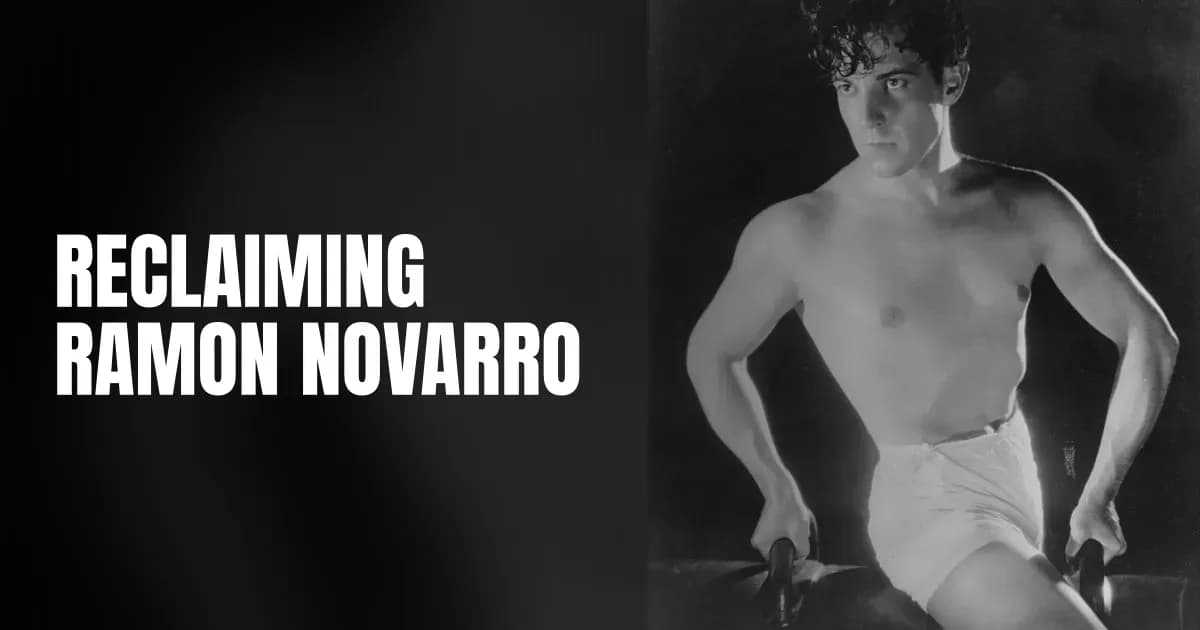
Ramon Novarro was a giant of silent Hollywood, a Mexican-born sex symbol whose elegance and talent earned him screen time opposite legends like Joan Crawford and Greta Garbo. He was also gay, a fact he kept hidden throughout most of his career-a secret shared only with those he trusted. In 1968, Novarro was murdered by two young men who broke into his home, an act that sparked a media sensation. At trial, his sexuality became a weapon. The "gay panic" defense dominated the narrative, posthumously weaponizing his queerness and cementing a legacy of scandal rather than artistry.
Reclaiming a legacy
Nearly 60 years later, filmmaker and Cuban-American Kevin Rios has set out to tell a different story. His short film "Latin Lover" blends fact and fiction to reimagine Novarro not as a victim, but as a complex man worthy of his own narrative. The film was inspired partly by Quentin Tarantino's willingness to rewrite Hollywood history in 2019's "Once Upon a Time in Hollywood," a gesture that made Rios realize Novarro deserved similar treatment.
"Novarro's life has been defined by a violent, sensationalized narrative," Rios explained in a press statement. "I wanted to restore his dignity and give him a final moment of connection. This film is about the man, not just the crime."
To research the film, Rios immersed himself in the trial documents, mining real details to ground the story: the setting in Laurel Canyon, the era itself, and even small intimate traces like the name "LARRY" inscribed on Novarro's sheet. These facts became the foundation for a surreal, dreamlike tale that weaves between the magical and the macabre of late-'60s Los Angeles, shot on film to authentically capture both the grit and beauty of the era.
Casting and honoring legacy
To embody Novarro, Rios cast Jonathan Del Arco, an openly gay Latino actor best known for his roles on "The Closer" and across the "Star Trek" universe. Del Arco saw the project as an opportunity to honor not just Novarro's talent, but his pioneering place in queer and Latino cinema.
Ramon Novarro was a groundbreaking talent whose achievements helped pave the way for generations of Latino and LGBTQ performers. What moved me most about this project was the opportunity to honor the fullness of his life-not simply the tragedy that has come to define it.
Jonathan Del Arco
Del Arco's recognition reflects a larger truth: Novarro's contributions to Hollywood have been overshadowed by the circumstances of his death. As one of the top box office attractions of the 1920s and early '30s, Novarro broke barriers for Latino performers in an industry that rarely saw them as leading men. Yet that pioneering status faded from public memory, replaced by the sensationalism of his murder and the homophobic framing that followed.
The supporting cast includes Robert Solomon and Rowen Kahn as Novarro's would-be assailants, alongside Blaise Godbe Lipman, Benny Burns, and Alessandra Mesa.
From festival to archives
"Latin Lover" made its world premiere at the Outshine LGBTQ+ Film Festival in Miami, Rios's hometown, where it won the Audience Award. The film has since screened at the Los Angeles Latino International Film Festival and has been accepted into the Cherry Grove Archives Collection, positioning it for continued viewership as part of the Cherry Grove Archival Film Festival this July.
Why this story matters now
The act of revisiting Novarro's story through a filmmaker's eye is itself a reclamation. For decades, the dominant narrative has been one of victimhood and scandal-a cautionary tale filtered through the prejudice of his era. What Rios offers instead is specificity and humanity: a man, a final evening, a moment of connection. By using real details from the trial, he grounds the film in truth while allowing space for dignity and complexity that the historical record, shaped by homophobia, stripped away.
In centering Novarro's full humanity rather than the violence done to him, "Latin Lover" does what good art often does: it challenges us to see someone not through the distorting lens of tragedy, but as themselves-a pioneering artist whose legacy deserves to be remembered on its own terms.
Source: Queerty
Cover photo: George Hurrell, Public domain, via Wikimedia Commons